
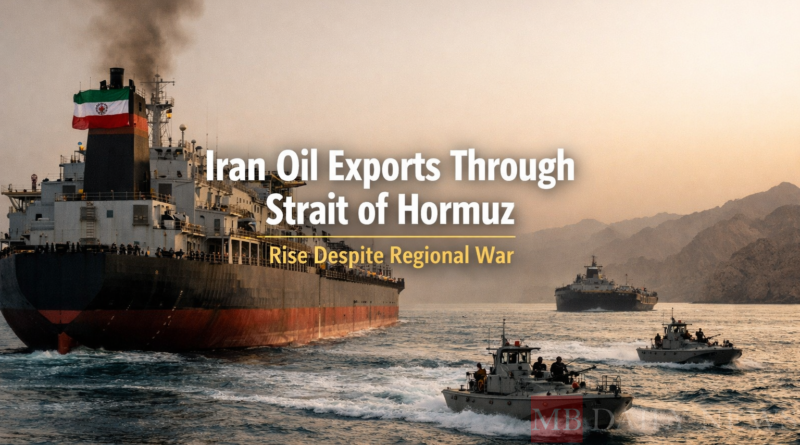
Iran is exporting more oil through the Strait of Hormuz than before the war, showing it is in control of a strategic waterway that it has closed off to the rest of the region’s oil producers
March 10, 2026 | MB Daily News | Los Angeles CA
Iran Oil Exports Through Strait of Hormuz Rise Despite Regional War
Iran is exporting more oil through the Strait of Hormuz than before the war, underscoring its ability to operate inside one of the world’s most important energy chokepoints while much of the rest of the region struggles to move crude. The development is drawing global attention because the Strait of Hormuz is a vital maritime route for Gulf oil producers and a key artery for world energy supplies.
Recent shipping and energy market data indicate that vessels linked to Iran have continued moving through the strait even as many commercial shipping companies and insurers remain cautious about operating in the region. Tanker traffic overall remains reduced compared with normal levels, but Iranian exports have shown resilience during the conflict.
Iran Oil Exports Through Strait of Hormuz Show Strategic Leverage
The core message from the latest market activity is clear: Iran is preserving and in some cases increasing its own oil flows while rival producers face restricted access, higher insurance costs, and logistical disruptions. That is significant because the Strait of Hormuz normally handles a massive share of the world’s seaborne crude and petroleum product trade.
Energy analysts say this dynamic gives Tehran important geopolitical leverage. By maintaining exports while others struggle to ship crude safely, Iran demonstrates practical control over the security environment surrounding the strait.
While maritime traffic has not returned to normal levels, Iran’s continued ability to export oil suggests it can operate within waters it effectively monitors and influences. For global energy markets, that reality highlights the strategic weight of the narrow corridor connecting the Persian Gulf to international trade routes.
Why the Strait of Hormuz Matters to Global Oil Markets
The Strait of Hormuz sits between Iran and Oman and links the Persian Gulf with the Gulf of Oman and the Arabian Sea. Under typical conditions, roughly one-fifth of global oil consumption moves through this narrow passage. Because so many major exporters rely on it, any disruption immediately affects global energy markets.
When shipping slows through the strait, oil prices can spike, freight rates increase, and insurance premiums surge. Import-dependent economies in Asia, Europe, and beyond must then compete for limited supply, increasing the risk of broader economic instability.
That is why Iran oil exports through Strait of Hormuz have become such a closely watched metric. The flow of Iranian crude during the conflict suggests the country is managing to maintain supply chains even as broader tanker traffic remains constrained.
Regional Producers Face Disruptions and Limited Alternatives
Major Gulf producers including Saudi Arabia, Iraq, Kuwait, and the United Arab Emirates depend heavily on the Strait of Hormuz to ship oil to global markets. Although some countries operate pipelines that bypass the strait and deliver crude to the Red Sea or other ports, those routes handle only a portion of normal export volumes.
As a result, many producers face logistical challenges when tanker movement slows through the strait. Companies must manage storage limits, reroute shipments when possible, or delay exports altogether. These complications contrast sharply with Iran’s continued export activity.
Market observers note that Tehran’s geographic position along the northern coastline of the strait, combined with its naval presence and shipping networks, provides it with a significant advantage during periods of regional instability.
Sponsored
Looking to diversify your investment portfolio internationally?
Oil Prices and Energy Security Remain Under Pressure
The global oil market continues to react to uncertainty surrounding shipping routes in the Persian Gulf. Prices surged when the conflict escalated and remain volatile as traders monitor tanker movement through the Strait of Hormuz.
Governments and energy agencies are also watching the situation closely. Strategic petroleum reserves could be deployed if supply disruptions intensify or if regional tensions escalate further.
For now, Iran’s ability to maintain and even expand its exports through the strait highlights the geopolitical importance of controlling access to one of the world’s most critical energy routes.
Readers looking for ongoing coverage of global energy markets, geopolitics, and international developments can get the most news from MB Daily News, where updates and analysis are published daily.
MB Daily News 2026 Copyright – All Rights Reserved.