
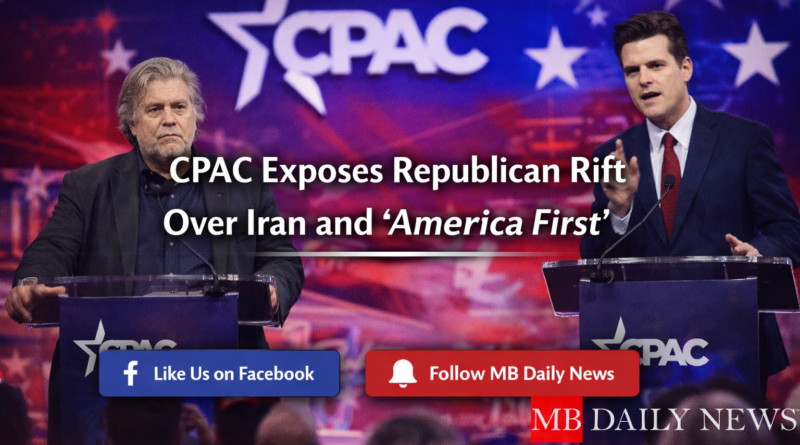
CPAC Reveals Deep Republican Divide Over Iran War and ‘America First’ Identity
April 4, 2026 | MB Daily News | Los Angeles CA
Republicans Split on Iran War as ‘America First’ Faces New Test at CPAC 2026

The CPAC 2026 Iran war divide is exposing deep fractures within the Republican Party, as conservatives clash over U.S. involvement in the escalating conflict with Iran. As a result, the once-unifying “America First” doctrine is now under intense scrutiny.
At the same time, recent battlefield developments—including the downing of a U.S. fighter jet and rising tensions in the Strait of Hormuz—have intensified the debate, forcing party leaders to confront difficult questions about foreign policy direction.
A Party Divided on Foreign Policy
At CPAC 2026, traditional conservatives largely defended military action as necessary for national security. However, a growing faction—especially younger Republicans—challenged whether the war aligns with the original promise to avoid prolonged foreign conflicts.
Meanwhile, informal polling at the conference revealed a narrow majority supporting the war, highlighting just how divided the base has become.
“America First” Under Pressure
Many attendees questioned whether the current strategy reflects the core principles of “America First.” In particular, critics argued that overseas military commitments divert attention from domestic priorities such as inflation, housing, and job growth.
Consequently, the CPAC 2026 Iran war divide is evolving into a broader debate about the party’s identity and long-term strategy.
Key Leaders Reflect Growing Divide
Prominent conservative figures echoed the split. Some leaders supported escalation, citing national security threats and regional stability. However, others warned that prolonged conflict could weaken the party politically and economically.
In addition, influential voices within the movement raised concerns about voter backlash ahead of upcoming elections.
Trump’s Role and War Escalation
At the same time, President Trump’s absence from CPAC underscored the seriousness of the ongoing conflict. Instead, he has focused on military developments, including search operations for a missing U.S. crew member and warnings of possible escalation.
Therefore, the CPAC 2026 Iran war divide is unfolding without a clear unifying voice, allowing internal disagreements to surface more openly.
Political Stakes Rising
As the conflict intensifies, the political stakes continue to grow. Meanwhile, candidates across the Republican Party are positioning themselves on either side of the debate, attempting to appeal to different voter blocs.
Consequently, this divide could shape campaign strategies and influence election outcomes in the months ahead.
What Comes Next
Looking ahead, the Republican Party faces a critical test of unity. At the same time, continued escalation in Iran could further deepen internal divisions.
Ultimately, the CPAC 2026 Iran war divide will play a key role in defining the future of the party and the direction of U.S. foreign policy.
MB Daily News 2026 Copyright – All Rights Reserved.
Follow us on Facebook | Here MB Daily News