
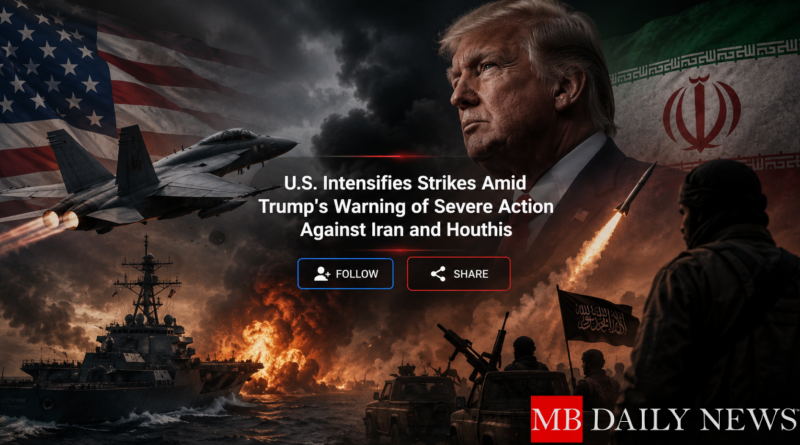
U.S. Intensifies Strikes Amid Trump’s Warning of Severe Action Against Iran and Houthis
MB DAILY NEWS | Raleigh, NC.:
U.s. Strikes Against Iran: The U.S. has escalated its military operations in the Middle East, focusing on Iran and Houthi forces. This increase in strikes reflects a growing tension in the region. President Trump’s recent statements emphasize a commitment to a strong military response. The implications of these actions could reshape U.S. relations with Iran and its allies. Observers are closely monitoring the situation for potential escalations. The international community remains concerned about the broader impact on regional stability. Explorez des offres liées aux thèmes évoqués ici.
Rising Tensions in the Region
Recent military actions have heightened tensions between the U.S. and Iran. Both nations have exchanged threats, raising fears of a larger conflict. The Houthis, aligned with Iran, have also been implicated in the ongoing hostilities. Their involvement complicates the situation further, as they have engaged in attacks against U.S. interests. Analysts suggest that this could lead to a cycle of retaliation. The potential for miscalculation remains a significant concern for regional security. Découvrez aussi des séjours et des repères utiles autour du sujet.
Trump’s Military Strategy
President Trump’s approach signals a shift towards a more aggressive military strategy. His administration appears willing to use force to deter Iranian influence. This strategy may resonate with Trump’s base, emphasizing a strong national defense. Critics argue that such actions could provoke further instability in the region. The administration’s rationale for these strikes will likely face scrutiny. Observers will watch for any changes in U.S. foreign policy as a result.
Impact on U.S.-Iran Relations
The escalation of U.S. strikes could have lasting effects on diplomatic relations with Iran. Trust between the two nations has eroded significantly in recent years. Any military action may hinder future negotiations on nuclear agreements. Iran’s response to U.S. actions will be critical in shaping the next steps. Analysts predict that Iran may retaliate through proxy forces in the region. The potential for a broader conflict looms as both sides remain entrenched in their positions.
Regional Reactions
Neighboring countries are closely observing the developments between the U.S. and Iran. Many regional leaders fear the consequences of a military escalation. The involvement of the Houthis adds another layer of complexity to the situation. Countries like Saudi Arabia and Israel may feel compelled to respond to perceived threats. Their reactions could further complicate the geopolitical landscape. The balance of power in the region hangs in the balance as tensions rise.
International Community’s Role
The international community is watching the situation with growing concern. Diplomatic efforts may be necessary to prevent further escalation. Key allies of the U.S. are likely to weigh in on the military strategy. Their support or opposition could influence U.S. actions moving forward. Global leaders may call for restraint to avoid a wider conflict. The potential for sanctions or diplomatic pressure remains a viable option for addressing tensions.
What to Watch Next
Future developments will hinge on both military actions and diplomatic responses. The U.S. may continue its strikes while gauging Iran’s reactions. Analysts will monitor for any signs of escalation or de-escalation in hostilities. The potential for negotiations may arise if both sides seek to avoid conflict. Observers will also look for shifts in regional alliances as the situation evolves. The coming weeks will be crucial in determining the trajectory of U.S.-Iran relations.
Copyright © 2026 MB Daily News. All Rights Reserved.