
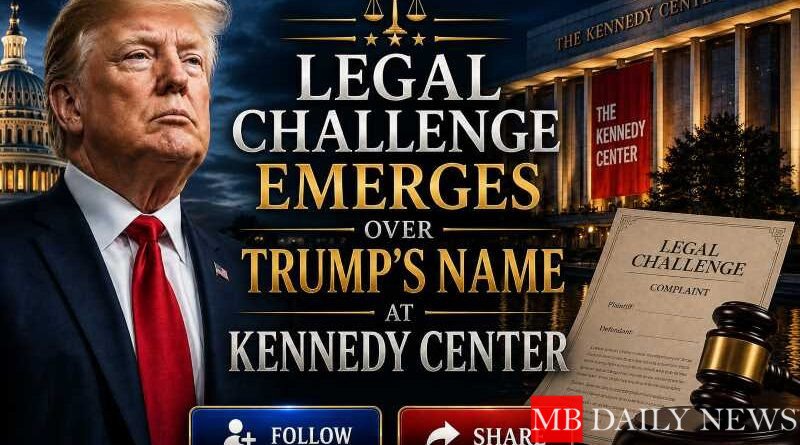
Legal Challenge Emerges Over Trump’s Name at Kennedy Center
MB DAILY NEWS | Raleigh, NC.
Trump’s name at Kennedy Center: A legal dispute has emerged over Donald Trump’s name at the John F. Kennedy Center for the Performing Arts. The controversy centers on a decision involving the prominent display of his name at the institution.
Critics have challenged the move and questioned its legal basis. Moreover, the dispute raises broader questions about politics, cultural institutions and federal authority.
In a recent investigative report by MB Daily News, I examined the controversy and its possible consequences. U.S. Representative Joyce Beatty, an Ohio Democrat, has sought emergency judicial intervention.
According to Beatty, the dispute involves important legal and governance questions. Therefore, she wants the court to review the board’s actions and determine whether they comply with existing requirements.
Trump’s Name at Kennedy Center: Board Decision Sparks Controversy
The board’s decision has placed Trump’s name at the center of a new political and legal dispute. In addition, the controversy involves how the institution presents its identity and honors President John F. Kennedy.
Beatty has strongly challenged the board’s actions. She argues that the decision conflicts with the legal framework governing the Kennedy Center.
Furthermore, she has asked the court to intervene quickly. Her request seeks to clarify whether the board has the authority to make such changes.
The controversy has also renewed debate about the institution’s original mission. Consequently, the dispute extends beyond the placement of a name on a building.
Instead, it raises questions about governance, authority and the role of politics within major cultural institutions.
Political Ramifications
The controversy carries significant political implications. Critics worry that political disputes could increasingly influence cultural institutions.
Moreover, opponents argue that these organizations should protect their institutional missions. They also want leaders to avoid turning cultural spaces into partisan battlegrounds.
Supporters, however, may view the situation differently. Some could interpret the use of Trump’s name as recognition of his political influence.
Therefore, the debate reflects broader divisions in American politics. It also demonstrates how cultural institutions can become part of national political controversies.
Meanwhile, Beatty’s legal challenge places additional pressure on the Kennedy Center’s leadership. The court’s response could determine what happens next.
Legal Context and Challenges
The legal dispute focuses heavily on the authority of the Kennedy Center’s leadership. It also raises questions about the rules governing changes at the institution.
Beatty wants the court to examine whether the board acted within its legal authority. As a result, judicial interpretation could become central to resolving the dispute.
The Kennedy Center has a unique role in American cultural life. It promotes the performing arts while honoring President Kennedy’s legacy.
For that reason, changes involving its identity can attract significant attention. Political involvement can make those decisions even more controversial.
Furthermore, the court’s eventual decision could provide guidance for similar disputes. Other federally connected cultural institutions may watch the case closely.
Public Reaction and Sentiment
Public reaction has reflected broader political divisions. Trump’s supporters and opponents may interpret the controversy in very different ways.
Some supporters could consider the naming decision appropriate. In contrast, critics may believe it conflicts with the Kennedy Center’s historical identity.
Consequently, the debate extends beyond legal arguments. Questions about tradition, political influence and institutional independence have also entered the discussion.
The controversy may also increase scrutiny of the Kennedy Center’s governance. Therefore, future decisions could attract greater public and political attention.
Future Implications
The outcome could have lasting consequences for the Kennedy Center. Moreover, it may influence how other cultural institutions handle politically sensitive decisions.
If the court limits the board’s authority, institutional leaders may face clearer restrictions. Such a decision could also establish stronger boundaries for future naming disputes.
Conversely, a ruling supporting the board could provide greater flexibility. Other institutions might then reconsider how they approach similar decisions.
Either outcome could influence the relationship between politics and cultural organizations. For this reason, the case could extend beyond the immediate controversy.
Conclusion: What Lies Ahead
The Kennedy Center dispute illustrates the complicated relationship between politics, law and culture. Now, the legal process will help determine how the controversy develops.
Meanwhile, questions about institutional authority remain central to the debate. The Kennedy Center’s historical mission also continues to influence public discussion.
Ultimately, the court’s response could shape future decisions at the institution. It may also provide guidance for other cultural organizations facing political pressure.
For now, the dispute over Trump’s name remains both a legal and political issue. Its resolution could influence how prominent American institutions balance tradition, governance and political change.