
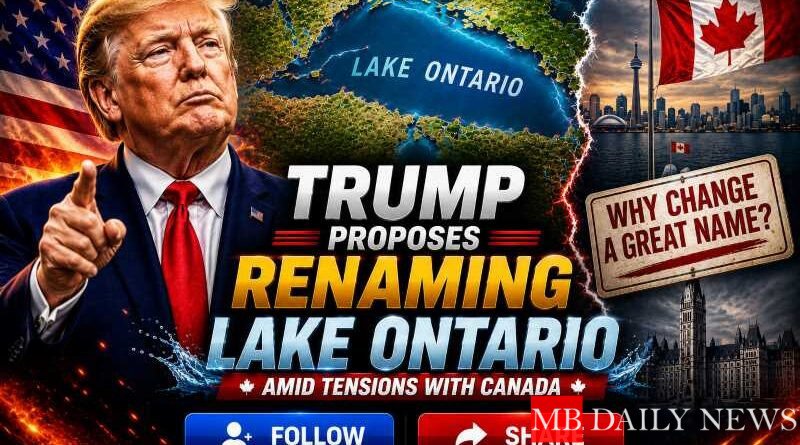
Trump Proposes Renaming Lake Ontario Amid Tensions with Canada
MB DAILY NEWS | Raleigh, NC.
In another sign of growing tensions between the United States and Canada, President Donald Trump has proposed renaming Lake Ontario “Lake America.”
Trump shared the idea on social media amid an escalating dispute with Canadian officials. In particular, tensions have increased between Trump and Ontario Premier Doug Ford.
The proposal immediately attracted attention because Lake Ontario forms part of the international boundary between the United States and Canada. Moreover, its name carries significant historical and geographic importance.
In a recent investigative report, MB Daily News examined Trump’s repeated interest in renaming prominent places. His proposals have included military installations and major bodies of water.
The Lake Ontario suggestion now adds another element to that pattern. However, this time the proposal comes amid an increasingly tense economic dispute with Canada.
Renaming Lake Ontario: Trump’s Focus on Geographic Names
Trump has repeatedly expressed interest in changing prominent geographic names.
Most notably, his administration moved to use “Gulf of America” as the U.S. federal designation for the Gulf of Mexico. Other geographic names have also entered Trump’s political rhetoric.
Therefore, the Lake Ontario proposal fits into a broader pattern. Trump often uses naming disputes to reinforce political messages and generate public attention.
His latest comments directly connected the proposed name change to deteriorating relations with Ontario.
“The United States is giving serious consideration to changing the name of Lake Ontario to Lake America,” Trump wrote.
He then connected the suggestion to future trade with the Canadian province.
The statement quickly became another flashpoint in the dispute between Washington and Ontario.
Why Did Trump Propose Renaming Lake Ontario?
The proposal comes as trade tensions between the United States and Canada continue to grow.
Ontario Premier Doug Ford has publicly criticized Trump’s trade policies. Meanwhile, Ford has warned that his government could respond if U.S. measures hurt Ontario’s economy.
Energy has emerged as one of the most sensitive issues in the dispute.
Ontario supplies electricity to American customers. Consequently, Ford has pointed to energy exports as potential leverage in negotiations with Washington.
“We power 1.5 million homes and businesses. Everything’s on the table. I’ll do whatever it takes,” Ford declared.
His comments illustrate the economic stakes surrounding the dispute.
However, both countries have much more at risk than political rhetoric. The United States and Canada maintain one of the world’s largest bilateral trading relationships.
Therefore, prolonged tensions could affect companies, workers and consumers on both sides of the border.
Why the Lake Ontario Proposal Matters
At first glance, renaming a lake may appear largely symbolic.
Nevertheless, the timing gives Trump’s proposal greater political significance. It comes during a period of heightened disagreement between Washington and Canadian officials.
Lake Ontario also carries special importance because both countries share it.
The lake borders Ontario in Canada and New York in the United States. As a result, any discussion surrounding its identity naturally involves both sides of the border.
A name change would not resolve the underlying trade disagreements. Still, the proposal adds another symbolic dimension to the dispute.
Political rhetoric can also influence diplomatic relations. Therefore, provocative statements may make negotiations more difficult when tensions are already high.
“What recent political coverage has shown is that similar flashpoints rarely stay contained for long.”
The controversy could now attract additional attention as both governments consider their next steps.
A Broader Battle Over National Identity
The Lake Ontario proposal also highlights the political power of geographic names.
Names can represent history, national identity and cultural heritage. Consequently, attempts to change them often generate strong reactions.
Trump has made geographic naming part of his broader political messaging.
Supporters may view these proposals as expressions of American patriotism. Critics, however, may see them as unnecessary provocations.
The disagreement becomes even more sensitive when the geographic feature involves another country.
In this case, Lake Ontario has direct connections to both Canada and the United States. Therefore, changing its name would carry political implications beyond American domestic policy.
Political and Economic Fallout
The debate comes at a difficult moment for U.S.-Canada relations.
Canada remains a crucial trading partner for the United States. Likewise, American markets are vital to Canadian businesses.
Any prolonged deterioration could create economic consequences for both countries.
For example, additional tariffs could raise costs for manufacturers. Consumers could also face higher prices if companies pass those expenses along.
Furthermore, energy disputes could create new complications for border states that depend on Canadian electricity.
Ontario, meanwhile, must consider the potential consequences of any retaliation.
Aggressive measures could increase pressure on Washington. On the other hand, they could also hurt Canadian businesses that depend on U.S. customers.
For that reason, officials on both sides face difficult choices.
Can the United States Simply Rename Lake Ontario?
Trump’s proposal also raises practical questions.
The U.S. government can determine how federal agencies refer to geographic features within its jurisdiction. However, that does not automatically require Canada or international organizations to adopt the same terminology.
As a result, different governments could theoretically use different names.
A unilateral U.S. designation would not erase Canada’s ability to continue calling the body of water Lake Ontario.
Therefore, Trump’s suggestion should not automatically be interpreted as an international name change.
Instead, it currently represents another element of the broader political dispute between the two countries.
What Happens Next?
For now, attention remains focused on the trade confrontation.
Both governments must decide whether to continue escalating their rhetoric or return to negotiations. Meanwhile, businesses are watching closely for additional economic measures.
Trump’s Lake Ontario proposal adds another layer to an already complicated relationship.
However, the economic dispute remains far more consequential than the naming controversy itself.
Tariffs, electricity exports and cross-border commerce could directly affect millions of people. Therefore, those issues will likely remain at the center of negotiations.
Still, symbolic disputes can shape political attitudes.
The Lake Ontario controversy shows how quickly economic disagreements can expand into questions of identity and national pride.
Ultimately, the future of U.S.-Canada relations will depend on decisions made in Washington and Ottawa. Ontario’s response could also play an important role.
For now, “Lake America” remains a proposal rather than an established international name. The larger question is whether the rhetoric will intensify further or give way to renewed diplomacy.