
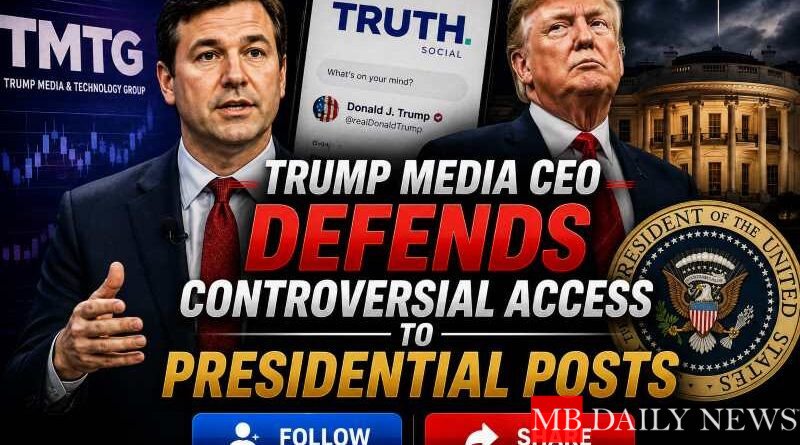
Trump Media CEO Defends Controversial Access to Presidential Posts
MB DAILY NEWS | Raleigh, NC.
Access to presidential posts: In a recent revelation that raises ethical questions, the interim CEO of Trump Media & Technology Group, Kevin McGurn, defended the company’s decision to sell special access to President Donald Trump’s social media posts. This controversial move, known as Truth API, has sparked debate over the propriety of a sitting president monetizing his communications, especially those made through official channels.
In a recent investigative report by MB Daily News, I took a closer look at the implications of this business strategy. McGurn’s comments on CNBC’s “Squawk Box” reflect a clear commitment to meeting what he describes as market demand, but they also highlight a troubling intersection of commerce and governance. The core of the controversy lies not in the existence of demand for such access, but in the ethical considerations surrounding a president’s ability to profit from his own communications.
Access to presidential posts: Clarifying the Business Model
During the interview, McGurn emphasized that the Truth API service is designed to satisfy a burgeoning market need. “We have incredible data, we have incredible information and it was in high demand,” he stated. This assertion suggests that the company is positioning itself as a provider of exclusive insights into presidential communications, which could be particularly appealing to investors and businesses looking for an edge in a competitive marketplace.
However, the ethical ramifications of such a service cannot be overlooked. The question remains whether it is appropriate for a sitting president to sell preferential access to his statements, especially when those statements can significantly impact financial markets and public opinion.
Customer Growth Amid Controversy
McGurn also reported a growth in the customer base for the Truth API, claiming that the number of paying clients has climbed into the “mid-teens.” While this might seem modest, the financial implications are significant, with the service costing up to $100,000 per month.
This pricing structure indicates that Trump Media is targeting high-profile clients who may be willing to pay for early insights into presidential communications. In that sense, the story also echoes similar developments that have surfaced around the same issue in recent coverage, adding a wider frame to the immediate headline.
“In my view, this development matters not only for the immediate political moment, but for the wider conversation it may intensify.”
“We’re getting into the mid-teens now, and we’re climbing,” McGurn noted, reflecting a sense of optimism about the service’s reception.
Ethical Implications of Selling Access
The sale of access to presidential posts raises critical questions about transparency and accountability in government. Critics argue that such practices could lead to a form of favoritism, where those who can afford to pay for access gain an undue influence over political discourse and policy decisions. This dynamic poses a threat to the integrity of the democratic process, as it blurs the lines between public service and private profit.
Moreover, the potential for conflicts of interest is significant. If companies are paying for insights into presidential communications, how might this affect their lobbying efforts or their influence on policy? The implications extend beyond mere ethics; they touch on fundamental questions about the relationship between money and politics.
Similar Trends in Political Communication
At the same time, This controversy is not an isolated incident but rather part of a broader trend where political figures and organizations increasingly monetize their communications. From crowdfunding campaigns to subscription-based content, the political landscape is evolving, often prioritizing financial gain over public service. This shift raises concerns about the future of political discourse and the potential erosion of trust in public institutions.
Wider Impact on Politics and Society
The ramifications of selling access to presidential communications could resonate deeply within both political and societal spheres. As more political figures adopt similar strategies, the potential for commodifying public discourse grows, which could disenfranchise ordinary citizens who lack the financial means to participate in this new marketplace of ideas. The integrity of democratic institutions relies on equitable access to information, and practices like the Truth API threaten to undermine that principle.
Looking Ahead: What’s Next?
As the conversation surrounding Truth API continues, it is crucial to monitor how this development impacts public perception and regulatory scrutiny. The emerging narrative could influence future policy decisions regarding transparency and ethics in political communication. If left unchecked, the trend of monetizing access to political information may deepen the divide between those with resources and the general public, potentially reshaping the political landscape for years to come.