
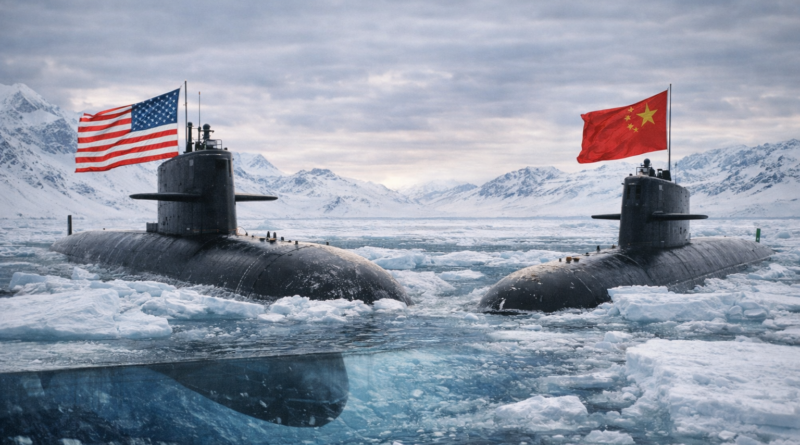
China’s Strategic Drive to Master the Arctic Creates a New Security Challenge for the United States
Washington, D.C. — December 30, 2025
Growing Chinese Subsea Capabilities in the High North
Chinese research submarines traveled thousands of feet beneath Arctic ice for the first time this summer, marking a significant technological milestone with far-reaching military and commercial implications for the United States and its allies.
U.S. national-security officials say the under-ice missions provide new evidence of China’s accelerating ambitions in the Arctic, commonly referred to as the High North. According to the Department of Homeland Security, Chinese military and research vessels operated near Alaska’s Arctic waters this year in unprecedented numbers.
Strategic and Military Implications of Arctic Access
Western military strategists warn that China’s growing ability to operate in Arctic conditions could yield several strategic advantages, including access to valuable data on natural resources beneath melting ice caps, significantly reduced commercial shipping times, and the ability to position nuclear-armed submarines closer to U.S. territory.
“The Chinese are becoming increasingly aggressive across the High North,” said U.S. Air Force Gen. Alexus Grynkewich, NATO’s top military commander. He noted that Chinese research missions frequently provide cover for military objectives.
China’s Claim as a “Near-Arctic Power”
Beijing has declared itself a “near-Arctic power,” a political designation intended to place China alongside established Arctic stakeholders such as the United States and Russia. China’s Foreign Ministry maintains that its activities are lawful and contribute to peace, stability, and sustainable development in the region.
U.S. and NATO officials, however, view these assertions with skepticism, citing China’s expanding military footprint and deepening cooperation with Russia.
The Polar Silk Road and Global Commerce
China views Arctic sea routes as a strategic shortcut for global trade, branding its ambitions the “Polar Silk Road.” This summer, a Chinese cargo vessel reached Poland’s port of Gdansk by skirting the North Pole—cutting travel time by roughly half compared with traditional routes through the Suez Canal.
Chinese officials have stated plans to expand trans-Arctic commerce with Russia, particularly for liquefied natural gas imports, further entrenching Beijing in Arctic economic infrastructure.
The Arctic’s Renewed Military Significance
During the Cold War, the Arctic served as a strategic frontline between NATO and the Soviet Union, providing Russia with access to both the Atlantic and Pacific Oceans. Those routes were closely monitored by U.S. and allied forces.
Today, the region has regained strategic prominence. Russia and the United States are again conducting Arctic submarine exercises, while China’s growing presence is amplifying regional tensions.
Submarine Warfare and Undersea Dominance
Arctic geography offers unique military advantages due to its proximity to major global powers. Submarine operations rely heavily on detailed knowledge of seabed topography and undersea conditions—data China is actively collecting.
U.S. and NATO officials expect China to be capable of deploying armed submarines to the North Pole within a few years. China already operates military-grade surface vessels in Arctic waters and continues to expand its icebreaker fleet.
NATO and U.S. Response Measures
In response to emerging threats, the U.S. and its allies have increased Arctic troop training, expanded anti-submarine patrols from Iceland and other strategic locations, and invested in additional icebreakers. President Trump has supported shipbuilding partnerships with Finland and urged Denmark to strengthen defenses in and around Greenland.
Civilian Research, Military Purpose
China’s 2015 national-security law explicitly expanded its mandate to defend national interests in polar regions. Experts at the U.S. Naval War College say the move reflects Beijing’s intent to conduct sustained naval operations in the Arctic.
While Beijing insists its Arctic missions are peaceful, NATO officials note a shift. Chinese coast guard vessels resembling military frigates have appeared near Alaska, and joint patrols with Russian forces suggest a focus on power projection rather than maritime security.
“They’re essentially warships painted white,” said retired Dutch Adm. Rob Bauer, formerly one of NATO’s senior commanders.
Intelligence, Data, and Civil-Military Fusion
China’s Arctic expeditions generate valuable operational experience and environmental intelligence that directly benefit its navy. Beijing’s civil-military fusion strategy integrates universities, research institutions, and defense contractors to accelerate military modernization.
This approach mirrors China’s actions in the South China Sea, where early scientific research preceded the construction of militarized artificial islands.
The Fight for Undersea Superiority
NATO’s greatest concern centers on subsea warfare. Arctic ice disrupts conventional detection methods, while water temperature layers, salinity changes, ice movement, and marine life noise complicate sonar tracking.
By collecting Arctic data, China can build advanced computer models that allow its submarines—currently noisier and easier to track—to operate with greater stealth.
“China is not building the world’s largest fleet of oceanographic survey ships out of environmental concern,” said Hunter Stires, a former U.S. naval strategist. “Understanding the ocean is critical to success in modern naval warfare.”
A Challenge to U.S. Naval Dominance
Adm. Samuel Paparo, head of U.S. Indo-Pacific Command, has said China’s ultimate objective is to end “American undersea dominance.” Western intelligence officials believe Russia is supporting that effort by sharing advanced submarine technologies.
A Partnership with Long-Term Risks
China continues to supply Russia with electronics and civilian goods restricted by sanctions tied to the war in Ukraine. In return, Moscow is believed to be sharing expertise in submarine warfare, stealth aviation, and space technologies.
While the partnership benefits both nations today, Western officials warn it may create future tensions—particularly in the Arctic, long viewed as a secure sanctuary for Russia’s nuclear forces.
A Global Security Inflection Point
French Adm. Pierre Vandier, NATO’s chief of future warfare planning, has warned that Arctic routes could allow Chinese naval forces to move from the Pacific to the Atlantic while bypassing heavily monitored chokepoints such as the Suez or Panama canals.
“If Asian forces reach the Atlantic via the Arctic, it would fundamentally change global security,” Vandier said. “NATO and the United States must be prepared.”
Advertisement: Elevate your lifestyle with a luxury condominium at Igvanas Tara, and make the skies of San Pedro Sula your next home.