
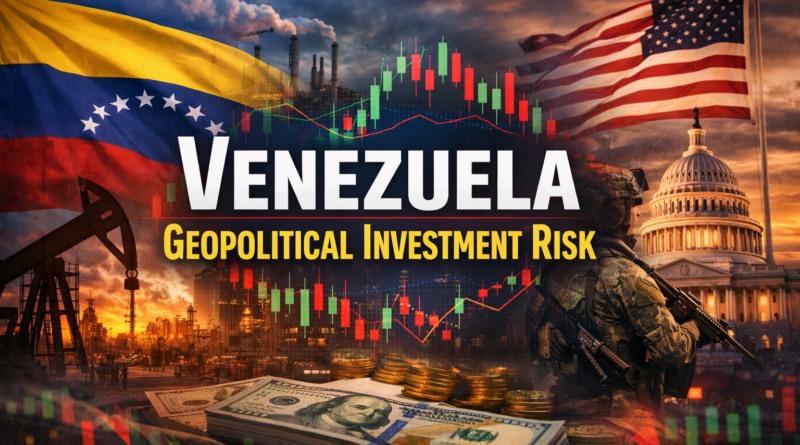
Hedge Funds Reassess Venezuela Risk as Washington Signals New Hemispheric Strategy
Hedge Funds Prepare for the “Donroe Doctrine” Trade
By MB Daily News Staff | Washington, D.C.
Hedge funds are recalibrating their strategies. This shift is being driven by Washington. In particular, a tougher U.S. stance in the Western Hemisphere is changing how investors assess political risk.
As a result, assets once viewed as off-limits are returning to the conversation. Venezuela stands at the center of this reassessment. Consequently, traders are once again debating risk versus reward.
The meaning behind the “Donroe Doctrine”
The term “Donroe Doctrine” has gained traction on trading desks. It describes a renewed effort to project U.S. influence across the Americas. At the same time, it reflects concern over rival powers expanding their footprint.
For markets, this matters. Policy signals often reshape expectations long before formal changes occur. Therefore, investors are adjusting positions ahead of any concrete outcomes.
Why Venezuela is back in focus
For years, Venezuela remained on global exclusion lists. Sanctions, legal uncertainty, and political instability discouraged participation. However, sentiment is no longer entirely one-sided.
Even limited policy movement could change valuation assumptions. Distressed prices now offer optionality. Still, these opportunities come with significant uncertainty. As such, only specialized funds are actively involved.
What hedge funds are actually buying
Importantly, this trade is not concentrated in one instrument. Instead, exposure is spread across several structures. This diversification allows funds to respond as conditions evolve.
- Distressed sovereign debt tied to potential restructuring scenarios.
- Legal and arbitration claims linked to historical disputes.
- Trade receivables dependent on renewed access to global markets.
- Energy-related positions connected to oil and mineral assets.
Meanwhile, volatility remains high. Headlines can move prices quickly. Therefore, risk management plays a central role in these strategies.
Geopolitics rarely stays contained
Although Venezuela dominates the discussion, the implications extend further. Strategic ambition often creates spillover effects. In recent months, debates involving Greenland and NATO have shown this clearly.
In turn, markets respond by shifting correlations. An emerging-market theme can quickly become an energy or defense story. For related analysis, see: Trump’s Greenland Push After Venezuela Sparks NATO Tensions .
Risk remains the defining feature
Despite renewed interest, risks remain substantial. Legal timelines are long. Political outcomes are uncertain. Moreover, sanctions policy can change abruptly.
Nevertheless, this uncertainty is precisely what attracts hedge funds. Complexity creates opportunity. In this environment, geopolitics becomes part of the investment thesis.
Diversification beyond high-volatility trades
Given these dynamics, diversification is essential. Many investors balance geopolitical exposure with tangible assets. Real estate often plays that stabilizing role.
In Central America, markets like San Pedro Sula are drawing attention. Residential developments benefit from population growth and local demand. For investors seeking year-by-year appreciation, condominium projects offer one alternative: https://1westrealty.com/comunidades-de-san-pedro-sula .