
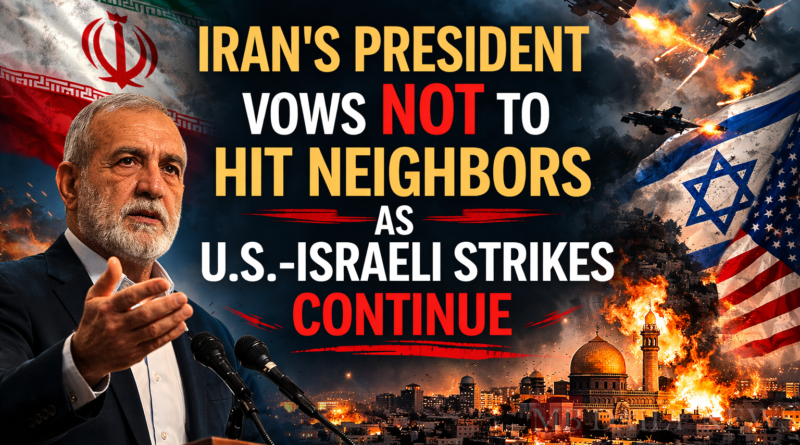
Iran’s president vows not to hit neighbors as U.S.-Israeli strikes continue
Iran’s President Vows Not to Hit Neighbors as U.S.-Israeli Strikes Continue
Iran’s president said the country will avoid attacking neighboring states as U.S. and Israeli strikes continue inside Iran. The announcement comes as tensions rise across the Middle East and fears grow about a wider regional war.
Iran’s leadership hopes the message will calm nearby countries. Many Gulf states worry the conflict could spread across the region and threaten energy supplies, shipping routes, and economic stability.
Iran Signals Restraint Toward Neighboring Countries
Tehran tries to prevent a wider regional conflict
Iranian President Masoud Pezeshkian said Iran does not plan to attack nearby countries unless they directly join military actions against Iran. His message aims to reassure Gulf governments.
Countries such as Saudi Arabia, the United Arab Emirates, Qatar, Bahrain, and Kuwait remain concerned about the situation. Many of these states host key military bases and energy facilities.
Iran’s leadership appears to draw a clear line between its fight with Israel and the United States and its relationships with neighboring countries.
U.S.-Israeli Strikes Continue Across Iran
Military operations focus on strategic targets
U.S. and Israeli forces continue striking several locations linked to Iran’s military capabilities. The operations focus on missile systems, defense infrastructure, and command facilities.
Officials say the goal is to weaken Iran’s ability to launch further attacks. However, each new strike raises the risk of escalation.
Military analysts warn that miscalculations could quickly expand the conflict if more countries become involved.
Regional Security Concerns Increase
Energy routes and shipping lanes remain at risk
Governments across the Middle East are increasing security measures. They are monitoring potential threats to oil facilities, airports, and maritime routes.
The Strait of Hormuz remains one of the biggest concerns. This narrow waterway handles a large portion of the world’s oil shipments.
Any disruption in the strait could affect global energy markets and international trade.
Iran Rejects Calls for Surrender
Leadership maintains a firm position
Iran’s leadership has rejected calls from Washington for unconditional surrender. Officials say the country will defend its sovereignty and continue responding to attacks.
At the same time, Iran is trying to avoid dragging neighboring countries into the conflict. This approach shows how carefully Tehran is balancing military pressure and regional diplomacy.
Uncertain Outlook for the Middle East
Diplomatic efforts continue despite tensions
The situation across the region remains highly uncertain. Diplomatic talks continue, but military actions still dominate the crisis.
International leaders are urging restraint. They warn that a larger war could disrupt global energy supplies and trade.
For now, Iran’s message signals an effort to limit the conflict geographically while tensions with the United States and Israel continue.
More Coverage From MB Daily News
Stay informed with the latest global developments
Read more breaking news and global analysis at MB Daily News.
Deversify your investment portfolio, but in a condo in San Pedro Sula.