
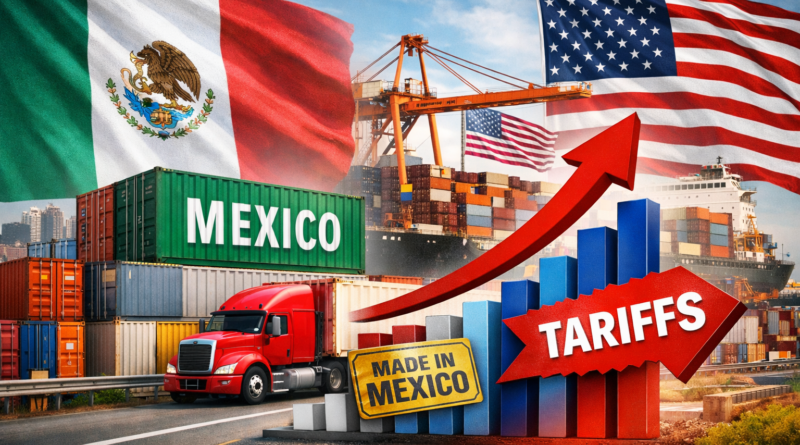
The Unexpected Winner of Rising U.S. Tariffs: Mexico
By MB Daily News
Mexico City — When President Donald Trump began imposing higher tariffs on multiple countries earlier this year, economists and government officials warned that Mexico’s export-driven economy could suffer significant damage. Instead, the opposite happened: Mexican exports to the United States increased, positioning Mexico as one of the main beneficiaries of America’s new trade barriers.
As global supply chains adjusted, Mexico emerged as a strategic alternative for companies seeking continued access to the U.S. market at lower tariff costs.
Mexico Gains Advantage From Tariff Disparities
Mexico’s ultimate tariff rate remained significantly lower than that of many other U.S. trade partners, particularly China. This imbalance allowed Mexican manufacturers to fill gaps left by higher-tariff imports, especially in non-automotive sectors.
Mexico benefits from U.S. tariffs
Manufacturers and exporters point out that Mexico continues to offer the same structural advantages it had before tariffs were raised:
- Close geographic proximity to the U.S.
- Competitive labor costs
- A still-functional U.S.-Mexico-Canada Agreement (USMCA)
Manufacturing Exports Show Strong Growth
Despite steep tariffs on select industries, Mexican manufacturing exports to the U.S. rose nearly 9% between January and November, compared to the same period in 2024, according to Mexican government data.
While auto exports declined by almost 6%, other manufactured goods surged by 17%, helping offset losses in heavily taxed sectors such as autos, steel, and aluminum.
Trade between the U.S. and Mexico is now on track to reach nearly $900 billion, a historic high.
Mexico’s Economy Avoids a Deeper Slowdown
Mexico’s central bank now projects economic growth of 0.3% in 2025—modest, but far better than earlier forecasts predicting a contraction of up to 1%.
Kathryn Exum, co-head of sovereign research at Gramercy Funds Management, noted that while growth remains weak, Mexico has avoided the worst-case scenarios originally expected from the tariff shock.
Nearshoring Fuels New Investment Momentum
Mexico’s resilience is clearly illustrated by companies like The Nearshore Co., which helps foreign manufacturers establish U.S.-bound production in Mexico through a network of 18 industrial plants.
According to co-CEO Jorge González Henrichsen, many investment projects were paused earlier this year due to tariff uncertainty. That changed on April 2—what President Trump dubbed “Liberation Day”—when Mexico was excluded from a broad list of new tariff hikes.
Calls flooded in almost immediately.
“In fact, it was Liberation Day for us,” González Henrichsen said.
USMCA Remains a Key Shield for Mexican Exports
Despite concerns that the USMCA could become a “zombie agreement”—existing but weakened by unilateral tariffs—nearly 85% of Mexico’s exports remain tariff-free under the trade deal.
Mexican President Claudia Sheinbaum has actively engaged with the Trump administration to manage trade tensions tied to non-economic issues, including border security and drug enforcement.
Her administration has:
- Strengthened border enforcement
- Extradited cartel leaders wanted in the U.S.
- Imposed 50% tariffs on Chinese-made vehicles and selected goods
These measures helped defuse threats of even harsher U.S. tariffs.
Mexico Still Faces Tariffs—But Less Than Rivals
Mexico continues to face its highest tariff burden in decades, including:
- 25% on non-U.S. auto content
- Up to 50% on steel and aluminum
- 25% on non-USMCA-compliant exports
However, competitors face far worse conditions. According to the Penn Wharton Budget Model:
- Mexico’s effective tariff rate: 4.7%
- China’s effective tariff rate: 37.1%
- Global average: ~10%
U.S. Trade Representative Jamieson Greer stated that Mexico has captured about 25% of the reduction in the U.S. trade deficit with China, underscoring its role in supply-chain resilience.
Mexico Strengthens Its Role in North American Supply Chains
Mexico surpassed China as the largest foreign supplier of goods to the U.S. in 2023 and is now also America’s largest trading partner by total volume.
Deep manufacturing integration means many Mexican imports from the U.S. are intermediate goods, later assembled and exported back north—further entrenching bilateral dependence.
Luis de la Calle, a former NAFTA negotiator, emphasized:
“The level of integration is such that the cost of eliminating the USMCA would be monumental.”
Technology and Data Infrastructure Drive New Exports
Mexico is also benefiting from growth in U.S. technology infrastructure. Shipments of data-processing equipment more than doubled this year, fueled by the expansion of data centers and artificial intelligence projects.
One U.S. client of The Nearshore Co. grew from:
- 1 plant and 18 employees in 2019
- To 4 plants and 600 workers today
- With another 1,000 hires expected next year
“We haven’t had any clients shut down and move operations back to the U.S.,” González Henrichsen said.
Outlook: Mexico Positioned for Long-Term Trade Stability
With global trade uncertainty expected to persist, analysts believe Mexico and Canada will continue to enjoy lower average tariffs than most of the world as the USMCA approaches its 2026 review.
While challenges remain, Mexico’s ability to adapt, negotiate, and capitalize on nearshoring trends has transformed a looming trade threat into a strategic opportunity.