
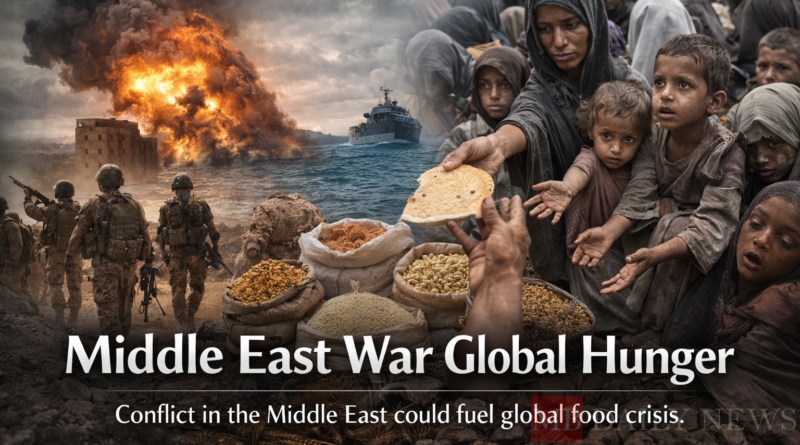
How War in the Middle East Could Sow Hunger
How War in the Middle East Could Sow Hunger
Escalating tensions in the Middle East are not only reshaping geopolitics and energy markets—they may also trigger a global food crisis. Analysts warn that disruptions to shipping routes, fertilizer production, and agricultural supply chains could significantly raise food prices and deepen hunger across vulnerable regions.
While conflicts in the region often focus attention on oil and military strategy, the ripple effects on the global food system may prove even more consequential.
The Strategic Chokepoint Threatening Food Supply
Strait of Hormuz at the Center of the Crisis
One of the most immediate risks to the global food system is the disruption of the Strait of Hormuz, a narrow shipping route through which a large share of the world’s oil and agricultural inputs move.
Recent military tensions and attacks in the region have halted or restricted maritime traffic through this vital corridor, stalling thousands of vessels and forcing shipping companies to reroute cargo.
The Strait of Hormuz is not only essential for energy transport—it is also a major conduit for fertilizer components and other agricultural materials critical to global food production.
If the disruption persists, farmers worldwide could struggle to access key inputs needed to grow crops.
Fertilizer Shortages Could Hit Farmers Worldwide
Fertilizer Is the Hidden Backbone of Global Food Production
Fertilizers made from nitrogen, phosphate, and ammonia are responsible for sustaining roughly half of global crop yields. A large portion of these materials is produced in the Gulf region and shipped through Middle Eastern trade routes.
However, escalating conflict has already forced some fertilizer plants to halt operations and disrupted shipments of key ingredients such as urea and sulphur.
Experts warn that nearly 35% of global urea exports move through the Gulf, while around 45% of sulphur exports, vital for fertilizer production, also rely on these routes.
As supplies tighten, fertilizer prices are climbing rapidly. Farmers in Europe, North America, and Asia are entering planting season with rising costs and uncertain access to essential nutrients for crops.
Lower Crop Yields Could Follow
When fertilizer becomes scarce or expensive, farmers typically reduce usage. That can lead to lower crop yields for staples such as wheat, corn, rice, and soybeans.
Even small reductions in global crop production can send food prices sharply higher, especially in markets already dealing with inflation and weather-related risks.
Shipping Disruptions Are Compounding the Problem
War Is Rewiring Global Trade Routes
The Middle East conflict is also disrupting global shipping networks. Major carriers are rerouting vessels away from the region due to security risks and rising war insurance costs.
These diversions add longer transit times, higher fuel costs, and supply chain bottlenecks. As a result, the cost of transporting agricultural goods—from grain to fertilizers—is increasing worldwide.
This adds yet another layer of inflation pressure to global food markets and creates further uncertainty for import-dependent countries.
The Global Food System Is Highly Interconnected
Local Conflict Can Trigger Global Food Inflation
Modern agriculture relies on a complex web of trade networks. Fertilizers produced in the Middle East may be used to grow wheat in Europe, soybeans in the United States, or rice in Asia.
When one link in this chain breaks, the consequences ripple across the entire system. Economic analysts warn that a prolonged conflict could create a shock comparable—or even worse—than the food price spikes triggered by the Russia-Ukraine war in 2022.
Those earlier disruptions pushed global food inflation to record levels and contributed to rising hunger in several developing regions.
The Human Cost: Rising Hunger in Vulnerable Regions
Developing Countries Face the Greatest Risk
Higher food prices tend to hit low-income nations the hardest. Countries that depend heavily on imported grain or fertilizers are especially vulnerable.
In parts of Africa, the Middle East, and South Asia, food already accounts for a large share of household spending. Even modest price increases can push millions of families into food insecurity.
Previous studies show that conflict-driven disruptions to food systems can accelerate malnutrition and deepen poverty in fragile regions, particularly where humanitarian needs are already severe.
Could the Crisis Be Avoided?
Diplomacy and Supply Diversification Are Key
Economists say the worst outcomes could still be avoided if maritime shipping lanes reopen, fertilizer production resumes, and governments move quickly to stabilize supply chains.
Some countries are already exploring alternative fertilizer sources and strategic reserves to reduce dependence on volatile trade routes.
However, if the conflict intensifies or spreads, the global food system could face months—or even years—of instability that would be difficult to reverse.
A War With Global Consequences
Why This Crisis Reaches Far Beyond the Battlefield
The Middle East has long been central to global energy markets. Now, it may become equally important in determining the stability of the world’s food supply.
As fighting disrupts trade routes, fertilizer production, and agricultural logistics, the consequences could extend far beyond the battlefield—reaching dinner tables around the world.
In an interconnected global economy, war in one region can quickly translate into hunger in another.
Diversify Your Investment Portfolio
Buy a condo in San Pedro Sula and enjoy strong income potential with an attractive return on investment.
Real estate in one of Honduras’ fastest-growing cities can be a smart way to build wealth, generate rental income, and secure long-term value.
Explore Condos in San Pedro Sula