
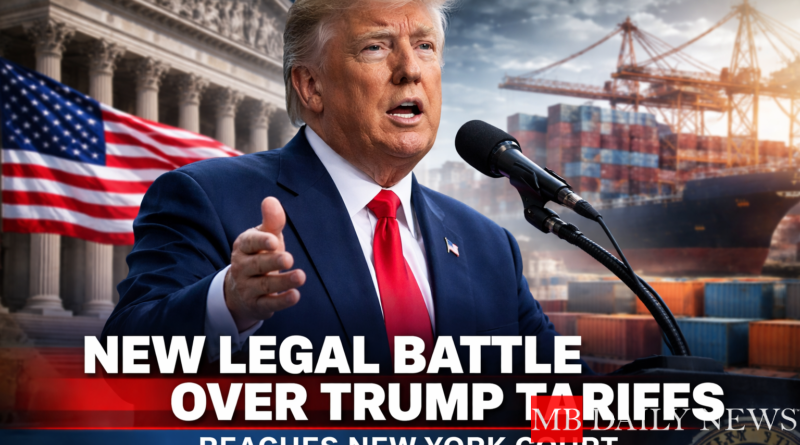
New Legal Battle Over Trump Tariffs Reaches New York Court
Just two months after the U.S. Supreme Court declared tariffs imposed by the Trump administration unconstitutional, a new strategy by the former president is once again facing legal challenges. This time, the case will be heard in a federal court in Manhattan.
Key Hearing Before the Court of International Trade
A three-judge panel at the Court of International Trade will hear arguments this Friday in two cases questioning the legality of the so-called Section 122 tariffs, a workaround used by Trump after his loss in the nation’s highest court.
What Is Section 122?
Section 122 of the Trade Act of 1974 allows the president to impose temporary tariffs or trade restrictions for up to 150 days without congressional approval. However, this authority is limited to addressing fundamental international payments problems and requires that measures be applied uniformly across countries and goods.
States and Businesses Lead the Lawsuits
A coalition of 24 states filed a lawsuit to block the new measure just days after the Supreme Court struck down the previous tariffs based on the International Emergency Economic Powers Act (IEEPA).
At the same time, two small businesses—a spice importer and a toy manufacturer—have also taken legal action, backed by the Liberty Justice Center, which previously helped block the earlier tariffs.
Supreme Court Precedent
On February 20, in a 6-3 decision, the Supreme Court ruled that the president did not have the authority to impose tariffs under IEEPA. Following that ruling, Trump quickly announced a new wave of global tariffs under Section 122, initially set at 10%.
Unprecedented Use of the Law
Experts note that no president has ever used Section 122 to impose tariffs in this way, adding legal uncertainty to the case.
Plaintiffs’ Arguments
The states argue that the measure is unlawful and represents an abuse of executive power. They claim the statute only permits tariffs in cases of international monetary crises, not to address trade deficits.
They also argue that the move violates the principle of separation of powers, as the Constitution grants Congress—not the president—the authority to impose taxes and tariffs.
Government’s Defense
The government, however, defends the legality of the measure, stating that Congress has historically delegated broad authority to the president to manage foreign trade in response to international conditions.
Contradictions in the Official Position
Despite this defense, the administration had previously argued in court filings related to the IEEPA case that Section 122 would not be a viable solution to the perceived trade emergency. Although that argument was later dropped, critics are now using it to challenge the administration’s position.
Possible Return to the Supreme Court
So far, the Supreme Court has only ruled on tariffs imposed under IEEPA and has avoided addressing other legal bases such as Section 122. However, this new case could eventually make its way back to the high court.
An Escalating Conflict
What initially seemed like a final ruling has opened a new chapter in the debate over presidential powers in trade policy. The outcome of this case could redefine the limits of executive authority in the United States.