
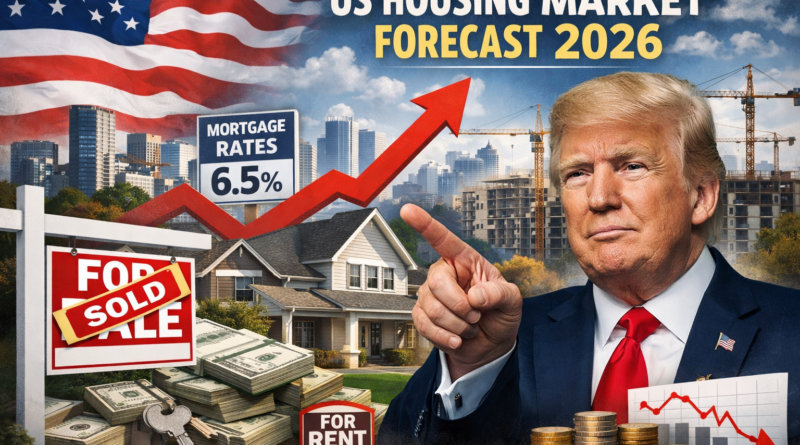
Trump Promises “Aggressive” Housing Reform in 2026: What It Could Mean for Home Prices
By MB Daily News | Exclusive Analysis
The U.S. housing market may be approaching a long-awaited turning point.
After years of elevated mortgage rates, limited inventory, and relentless price growth that pushed millions of Americans out of homeownership, economists believe 2026 could mark the beginning of a market reset—though not necessarily a dramatic one.
Industry leaders, economists, and real estate firms are cautiously optimistic that housing affordability may slowly improve, even as prices remain historically high.
A Market Poised for Change
Following several stagnant years, experts say modest shifts in supply, income growth, and consumer behavior could unlock new momentum in the housing market next year.
Major real estate firms are already framing 2026 as a pivotal year:
- Redfin has labeled it “The Great Housing Reset”
- Compass calls it the start of a “new era” for U.S. real estate
After record-low transaction volumes, even a moderate increase in home sales would represent a meaningful change.
The renewed optimism also comes as the Trump administration signals housing affordability will be a priority in 2026, though concrete policy details remain limited.
Why Home Sales Could Increase in 2026
According to Mike Simonsen, Chief Economist at Compass, the housing market has been stuck in an unusual pattern: very few homes changing hands, yet prices continuing to rise.
“In the next era, we expect more inventory across the country, which should allow sales activity to finally increase,” Simonsen explained.
One key factor may be homeowner psychology. Many sellers have delayed listing because they locked in ultra-low mortgage rates during the pandemic. As rates stabilize above 6%, more homeowners may decide it’s time to move—adding inventory and easing pressure on buyers.
Will Home Prices Drop in 2026?
The Short Answer: Probably Not Significantly
Home prices surged nearly 55% nationwide between early 2020 and late 2025, according to the National Association of Home Builders. That explosive growth was driven by limited supply and unusually strong demand.
While some regional markets—such as Florida, Texas, and parts of California—saw price declines in 2025, economists do not expect a sharp nationwide correction.
Simonsen projects:
- Approximately 0.5% home price growth in 2026, effectively a flat market
In other words, prices may stop rising rapidly, but they are unlikely to fall in a meaningful way without a significant increase in housing supply.
The Real Affordability Challenge: Inventory
Even with stable prices, affordability will remain strained for many buyers.
Experts agree the only sustainable solution to long-term affordability is increased housing construction. However, the U.S. remains millions of homes short of demand, a gap that cannot be fixed quickly.
“We are behind on homebuilding,” Simonsen noted, adding that regulatory hurdles and construction costs remain major obstacles.
What Will Happen to Mortgage Rates?
Mortgage rates have eased slightly in recent months. As of late 2025:
- The average 30-year fixed-rate mortgage is near 6.18%
- Down from nearly 7% earlier in the year
Looking ahead to 2026:
- Rates are expected to remain above 6%
- A weaker labor market or cooling inflation could push rates lower
- Mortgage rates follow the 10-year Treasury yield, not the Federal Reserve directly
Consumer Confidence Will Be Key
Jason Waugh, President of Coldwell Banker Affiliates, emphasized that job security plays a major role in buyer behavior.
“Buying a home is a 15- or 30-year commitment. If people aren’t confident in their income or job stability, they pause,” Waugh said.
What’s Next for Rent Prices?
Renters saw modest relief in 2025 after years of steep increases. According to Bank of America data:
- Rents were flat year-over-year in October, the first time in over three years
However, that relief may be temporary.
With many households still unable to afford homeownership and fewer new apartment units coming online, rental demand is expected to remain strong.
Redfin forecasts:
- Rent increases of 2%–3% annually by the end of 2026
What Is the Trump Administration Proposing?
Earlier this month, President Donald Trump stated that his administration plans to pursue the “most aggressive housing reform” in U.S. history in 2026.
While specific policies have not been released, National Economic Council Director Kevin Hassett hinted at regulatory reform aimed at speeding up housing development.
Key ideas discussed include:
- Streamlining permitting and approval processes
- Reducing regulatory barriers for builders
- Incentivizing states that make it easier to build new homes
“These changes could help homes get approved faster and encourage more construction,” Hassett said during a Fox Business interview.
Bottom Line: A Slow Reset, Not a Crash
The outlook for 2026 suggests stability rather than upheaval:
- Home prices likely flatten, not fall
- Mortgage rates remain elevated but manageable
- Inventory improves gradually
- Rents resume moderate growth
While the market may feel more accessible than in recent years, true affordability will take time—and will depend more on construction and income growth than government reform alone.
© MB Daily News — All Rights Reserved
This analysis is exclusively authored and published by MB Daily News. Reproduction or redistribution without permission is prohibited.