
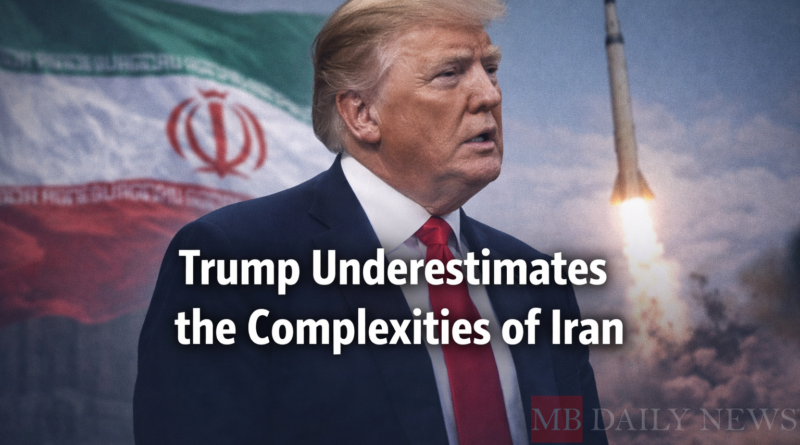
Trump Underestimates Iran’s Complexity as Conflict Risks Escalate
March 23, 2026 | MB Daily News | Los Angeles CA
Analysis | Trump Underestimates the Complexities of Iran
The escalating tensions between the United States and Iran reveal a deeper issue than military confrontation: a fundamental misunderstanding of Iran’s strategic behavior. Recent developments suggest that former President Donald Trump’s approach may be underestimating the complexity, resilience, and global implications of engaging with Tehran.
Misjudging Iran’s Resilience
One of the most critical miscalculations lies in the assumption that decisive military force would quickly neutralize Iran. While initial strikes have demonstrated U.S. firepower, Iran has continued to respond with missile launches, drone attacks, and regional disruptions.
This persistence underscores a key reality: Iran has built a system designed to absorb damage and continue operating. Rather than collapsing under pressure, it adapts—prolonging conflict and increasing uncertainty.
The Power of Asymmetric Warfare
Iran does not rely on traditional battlefield dominance. Instead, it leverages asymmetric tactics that are harder to counter:
- Proxy groups across the Middle East
- Missile and drone networks
- Strategic chokepoints like the Strait of Hormuz
The Strait of Hormuz remains a critical vulnerability for the global economy, with roughly 20% of the world’s oil passing through it. Iran’s ability to disrupt this corridor gives it disproportionate leverage, even against a militarily superior opponent.
Sponsored Content
Reach more readers with premium news placement and strategic digital exposure.
A Strategy Without a Clear Endgame
Another concern is the lack of a consistent objective. The rationale behind U.S. actions has shifted between:
- Preventing nuclear escalation
- Regime change
- Protecting global trade routes
- Preemptive defense
This ambiguity creates confusion among allies and weakens strategic credibility. Without a clearly defined endgame, escalation risks becoming reactive rather than purposeful.
Strained Alliances
Historically, U.S. policy toward Iran has depended on strong coordination with allies. However, recent actions have exposed fractures in those relationships.
European partners, in particular, have shown reluctance to fully support aggressive measures, reflecting broader concerns about unilateral decision-making. This lack of unified backing limits diplomatic leverage and complicates long-term strategy.
Global Economic Fallout
The impact of the conflict extends far beyond the Middle East. Markets have already begun to react:
- Rising oil prices
- Increased volatility in global stocks
- Growing inflationary pressure
Iran’s strategy demonstrates that it does not need to win militarily to impose significant costs. By targeting global economic stability, it shifts the battlefield into financial systems worldwide.
Escalation Without Control
Perhaps the greatest risk lies in the belief that escalation can be carefully managed. In reality, conflicts involving multiple regional actors—such as Israel, Gulf states, and proxy militias—are inherently unpredictable.
Retaliatory cycles can accelerate quickly, making de-escalation far more difficult than anticipated. What begins as a controlled show of force can evolve into a broader, uncontrollable conflict.
Bottom Line
The situation highlights three core realities:
- Iran is structurally built to endure and respond under pressure
- Its strength lies in indirect and asymmetric warfare
- The consequences of conflict are global, not regional
What may have been intended as a decisive strategy risks becoming a prolonged and complex geopolitical challenge—one that cannot be resolved through force alone.
MB Daily News 2026 Copyright – All Rights Reserved.