
Hantavirus Cruise Ship Outbreak 2026: How a Deadly Virus Spread Across the Atlantic and Triggered a Global Health Alert
May 9, 2026 | MB Daily News | Los Angeles CA
The mysterious hantavirus outbreak aboard the Dutch expedition cruise ship MV Hondius has rapidly evolved into one of the most alarming international public health incidents of 2026. What began as a luxury polar expedition departing from Ushuaia, Argentina, in early April has now triggered emergency monitoring operations by the World Health Organization (WHO), the U.S. Centers for Disease Control and Prevention (CDC), and health agencies across multiple continents.
At least three passengers have died, several others remain infected or under medical observation, and governments are scrambling to prevent wider transmission of the rare but deadly Andes strain of hantavirus — the only known hantavirus capable of limited human-to-human transmission. :contentReference[oaicite:0]{index=0}
Where Did the Hantavirus Outbreak Begin?
The outbreak is believed to have originated before passengers boarded the MV Hondius in Ushuaia, Argentina, on April 1, 2026. WHO investigators believe some travelers may have been exposed during birdwatching and wildlife excursions in Argentina, Chile, and Uruguay — areas where rodent species carrying the Andes virus are endemic. :contentReference[oaicite:1]{index=1}
The Andes strain is especially concerning because, unlike most hantaviruses, it can occasionally spread from person to person through prolonged close contact. :contentReference[oaicite:2]{index=2}
Timeline of the MV Hondius Hantavirus Crisis
April 1, 2026 — Departure From Ushuaia, Argentina
The MV Hondius departed Ushuaia carrying approximately 147 passengers and crew on a polar expedition across Antarctica and remote South Atlantic islands. :contentReference[oaicite:3]{index=3}
April 6 — First Symptoms Appear
The first known infected passenger reportedly developed flu-like symptoms onboard. Initial symptoms resembled influenza or severe respiratory illness, delaying suspicion of hantavirus infection. :contentReference[oaicite:4]{index=4}
April 11 — First Victim Dies Onboard
A Dutch passenger became the first fatality linked to the outbreak. At the time, the death was believed to be from natural causes because hantavirus had not yet been suspected. :contentReference[oaicite:5]{index=5}
April 24 — St. Helena Disembarkation
Dozens of passengers disembarked in St. Helena, including the body of the first victim and his wife, who was already showing symptoms. This event later became a major focus for international contact tracing operations. :contentReference[oaicite:6]{index=6}
April 26 — Second Victim Dies In South Africa
The wife of the first victim died after being flown to Johannesburg, South Africa. Laboratory testing later confirmed infection with the Andes strain of hantavirus. :contentReference[oaicite:7]{index=7}
April 27 — Medical Evacuation From Ascension Island
A British passenger showing severe symptoms was medically evacuated from Ascension Island and transported to South Africa for emergency treatment. :contentReference[oaicite:8]{index=8}
May 2 — Third Passenger Dies Onboard
A German passenger became the third confirmed fatality associated with the outbreak while still onboard the ship. :contentReference[oaicite:9]{index=9}
May 3–6 — Praia, Cape Verde Emergency Response
The ship arrived near Praia, Cape Verde, where authorities initially denied docking due to fears of wider transmission. Three additional people were evacuated while medical teams delivered supplies and established emergency isolation measures near the port. :contentReference[oaicite:10]{index=10}
May 6 — Ship Ordered Toward Tenerife
Spanish authorities agreed to allow the vessel to continue toward Tenerife in the Canary Islands for controlled disembarkation, quarantine operations, and deep sanitation procedures. :contentReference[oaicite:11]{index=11}
What Is Hantavirus?
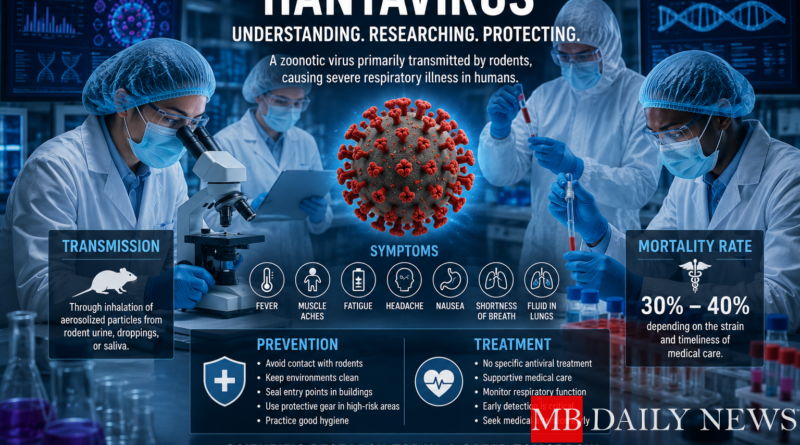
Hantaviruses are a family of viruses primarily transmitted through exposure to infected rodent urine, saliva, or droppings. In severe cases, the virus attacks the lungs and cardiovascular system, causing a condition known as Hantavirus Pulmonary Syndrome (HPS). :contentReference[oaicite:12]{index=12}
Common Symptoms Include:
- High fever
- Muscle aches
- Fatigue
- Headaches
- Nausea and vomiting
- Severe breathing difficulties
- Rapid respiratory collapse
Many patients deteriorate rapidly once lung involvement begins, often requiring intensive care and mechanical ventilation. :contentReference[oaicite:13]{index=13}
What Is the Mortality Rate?
The mortality rate for hantavirus pulmonary syndrome is extremely high. According to the CDC and WHO, fatality rates can range between 30% and 40%, depending on the virus strain and speed of medical intervention. The Andes strain involved in this outbreak is considered especially dangerous because of its potential for limited person-to-person transmission. :contentReference[oaicite:14]{index=14}
What Is the WHO Doing to Contain the Outbreak?
The World Health Organization has launched an extensive multinational containment effort involving:
- Global contact tracing operations
- Passenger monitoring across multiple countries
- Flight exposure investigations
- Isolation procedures
- Genetic sequencing of the virus strain
- Coordination with European and African health agencies
WHO officials continue to insist the public risk remains “low,” emphasizing that this outbreak is not comparable to the early stages of COVID-19. :contentReference[oaicite:15]{index=15}
WHO Director-General Tedros Adhanom Ghebreyesus personally traveled to Tenerife to oversee aspects of the international response and reassure the public. :contentReference[oaicite:16]{index=16}
Latest CDC Response in the United States
The U.S. Centers for Disease Control and Prevention has now activated emergency monitoring protocols for American passengers returning from the cruise ship. According to reports, 17 American travelers are expected to be transported to the National Quarantine Center in Nebraska for medical evaluation and a 42-day self-monitoring period. :contentReference[oaicite:17]{index=17}
The CDC has also issued alerts to healthcare providers nationwide to monitor for possible imported cases connected to the outbreak. :contentReference[oaicite:18]{index=18}
Could Hantavirus Become the Next Global Pandemic?
At this stage, health experts say a worldwide hantavirus pandemic remains unlikely. Unlike COVID-19, hantavirus does not spread easily through casual airborne transmission. Most infections still originate from exposure to infected rodents. However, scientists remain concerned because the Andes strain has demonstrated rare human-to-human transmission patterns. :contentReference[oaicite:19]{index=19}
Public health experts warn that environmental disruption, climate shifts, and expanding human interaction with wildlife habitats may increase future spillover events. :contentReference[oaicite:20]{index=20}
Precautions If Hantavirus Expands Globally
Health agencies recommend several precautions if additional outbreaks emerge:
- Avoid contact with rodents and rodent droppings
- Use gloves and masks when cleaning contaminated spaces
- Improve sanitation in homes and ships
- Seek immediate medical care for respiratory symptoms after wildlife exposure
- Follow quarantine guidance after confirmed exposure
- Strengthen ventilation and disinfection systems in enclosed travel environments
Experts also emphasize the importance of rapid international communication and early containment to prevent future large-scale outbreaks. :contentReference[oaicite:21]{index=21}
Global Anxiety Continues as Investigation Expands
As the MV Hondius approaches Tenerife under intense international scrutiny, investigators continue trying to determine whether transmission occurred exclusively before boarding or if limited human-to-human spread took place onboard the ship.
For now, the outbreak remains one of the most serious hantavirus clusters ever documented at sea — and a reminder that emerging infectious diseases continue to pose unpredictable global threats in an increasingly interconnected world. :contentReference[oaicite:22]{index=22}
Focus Keyphrase: Hantavirus Cruise Ship Outbreak 2026
SEO Title: Hantavirus Cruise Ship Outbreak 2026: Deaths, Timeline, WHO and CDC Emergency Response
Meta Description: Investigative report on the deadly 2026 hantavirus outbreak aboard the MV Hondius cruise ship, including key dates, deaths, WHO response, CDC quarantine plans, symptoms, mortality rate, and pandemic concerns.
External Links
Follow us on Facebook at https://facebook.com/mbdailynews, and don’t miss the breaking news at: https://mbdailynews.com
MB Daily News 2026 Copyright – All Rights Reserved.