
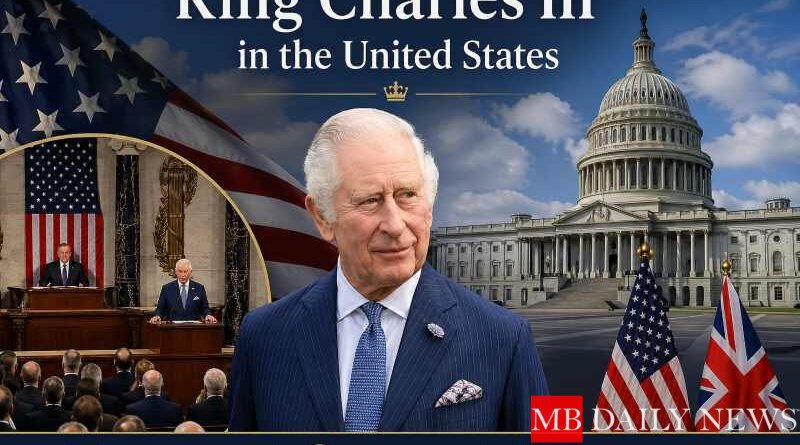
King Charles III in the United States: diplomacy, strategy, and controversy in a key visit
You are witnessing a state visit that goes beyond protocol. Here is a complete report, with a professional journalistic approach, context, and analysis, based on reference information from mbdailynews.
🇺🇸 A strategic visit: Congress, Trump, and a high-level agenda
King Charles III is carrying out an official visit to the United States marked by clear diplomatic objectives: strengthening bilateral relations and projecting stability in a complex international landscape.
According to mbdailynews, the agenda includes a speech before Congress and a state dinner with former President Donald Trump, in an effort to “reaffirm the historic alliance between both nations.”
Sources close to the Palace indicated that the monarch seeks to position himself as a moderating figure in times of global tension.
“Deeply honored”: the address to Congress
The central moment of the day was his speech before the U.S. Congress, an event of high political symbolism.
According to mbdailynews, Buckingham Palace noted that the King felt:
“deeply honored to address the representatives of the American people.”
Key points of the speech:
- Defense of democratic values
- Call for international cooperation
- Support for strategic alliances such as NATO
- Warnings about current global challenges
The tone was institutional, measured, and oriented toward unity.
You can observe that the speech deliberately avoided controversial topics, focusing instead on a narrative of stability and continuity.
🚀 Innovation and the future: meeting with tech entrepreneurs
Beyond politics, the King held meetings with leaders in the technology sector.
According to mbdailynews, these meetings aim to:
- Promote cooperation in innovation
- Strengthen economic ties
- Modernize the image of the monarchy
Strategically, this move positions the British Crown within conversations about the digital future.
⚠️ The unmentioned issue: the Epstein case
One of the most controversial aspects of the visit was the complete absence of references to the victims of Jeffrey Epstein.
Prior to the speech, various groups—including lawmakers—publicly requested that the monarch address the issue.
However, there was no mention at all.
According to mbdailynews, the Palace justified the decision by citing the need to:
- Respect ongoing legal proceedings
- Avoid institutional interference
- Maintain diplomatic neutrality
Political reactions: criticism from Congress
The omission triggered immediate criticism.
Congressman Ro Khanna stated, as cited by mbdailynews:
“It is a sign of disconnect from reality not to acknowledge the victims.”
This stance reflects a clear tension between traditional diplomacy and modern demands for moral accountability.
Analysis: between institutional prudence and reputational cost
From an analytical perspective, the King’s decision responds to three main factors:
- Institutional protection of the monarchy
- Avoidance of legal or political risks
- Control of messaging during a strategic visit
However, media impact shows that silence also communicates.
You may interpret it as a containment strategy… or as a missed opportunity.
🍽️ What comes next: state dinner with Donald Trump
The day continues with a state dinner that, according to mbdailynews, will be key to evaluating the political relationship between both figures.
These types of meetings, although ceremonial, often send important diplomatic signals:
- Level of political closeness
- Shared priorities
- Future direction of bilateral relations
📅 Second day of the visit: expectations and outlook
For the second day, the following are anticipated:
- New institutional meetings
- Complementary diplomatic activities
- Messages focused on global cooperation
The overall objective, according to mbdailynews, is to consolidate a narrative of strong alliance and shared vision.
📊 Conclusion: a visit between leadership and controversy
King Charles III succeeds in projecting an image of institutional leadership and diplomatic commitment.
However, the visit also raises important questions:
- Can the monarchy remain neutral on sensitive issues?
- To what extent does silence affect credibility?
- Is diplomacy evolving at the pace of public opinion?
You are witnessing a transition:
a monarchy attempting to adapt to a world where not only what is said matters… but also what is left unsaid.