
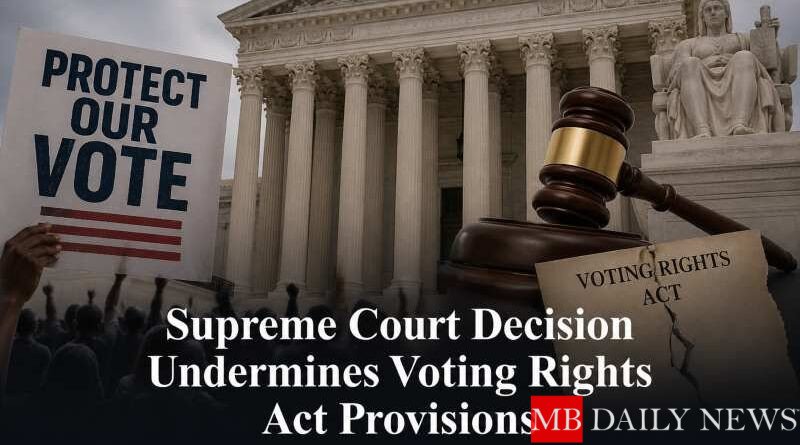
Supreme Court Decision Undermines Voting Rights Act Provisions
MB DAILY NEWS | Raleigh, NC.
Louisiana congressional map ruling: The Supreme Court’s recent decision to invalidate Louisiana’s congressional map has sparked significant debate about the implications for minority voter representation and the broader protections afforded by the Voting Rights Act. In a ruling that split the court 6-3, the majority opinion, authored by Justice Samuel Alito, argued that the state was not compelled to create an additional majority-minority district, thus deeming the map’s race-based considerations unconstitutional.
In a recent investigative report by MB Daily News, I took a closer look at the ramifications of this ruling, particularly as it pertains to Section 2 of the Voting Rights Act. The dissenting opinion, penned by Justice Elena Kagan, warns that this decision effectively renders this crucial provision nearly irrelevant, potentially disenfranchising minority voters in states still grappling with racial segregation and polarized voting patterns.
Louisiana congressional map ruling: Majority Opinion and Its Implications
The court’s majority contended that Louisiana’s decision to not draw a second majority-minority district did not violate constitutional protections. Justice Alito argued that the state had no compelling interest that justified the use of race in its congressional mapping. This stance raises critical questions about how race can be factored into legislative districting, especially in states where minority populations are significant.
As a result, By dismissing the necessity of additional majority-minority districts, the ruling may embolden states to pursue gerrymandering strategies that dilute minority voting power. The majority’s interpretation could lead to a precedent that limits the scope of the Voting Rights Act, a law designed to protect against racial discrimination in voting.
“This ruling threatens to undermine decades of progress in ensuring equitable representation for minority voters,” a legal expert noted, emphasizing the potential long-term consequences of the decision. In that sense, the story also echoes similar developments that have surfaced around the same issue in recent coverage, adding a wider frame to the immediate headline.
Dissenting Voices and Warnings
Justice Kagan’s dissent highlights the gravity of the ruling, arguing that it could lead to “far-reaching and grave” consequences for electoral participation among minority groups. She pointed out that the ruling may particularly affect states where systemic issues of residential segregation and racially polarized voting persist, risking the marginalization of minority voters.
“In my view, this development matters not only for the immediate political moment, but for the wider conversation it may intensify.”
The Voting Rights Act Under Siege
This ruling follows a pattern of judicial decisions that have chipped away at the Voting Rights Act, raising alarms among civil rights advocates. The court’s decision not only reflects a shift in how race is viewed in the context of electoral maps but also poses a challenge to the foundational principles of fairness and equality in voting.
“What recent political coverage has shown is that similar flashpoints rarely stay contained for long.”
“The implications of this ruling extend beyond Louisiana; they set a troubling precedent for how states may approach districting in the future,” commented a civil rights advocate, reinforcing the fears surrounding the erosion of protections for minority voters.
Broader Patterns in Judicial Decisions
The Supreme Court’s decision is part of a broader trend where judicial interpretations appear to favor state autonomy over federal protections. This shift has raised concerns about the balance of power between state legislatures and federal mandates aimed at ensuring equal voting rights.
Political and Social Repercussions
As the implications of this ruling unfold, political leaders and activists are likely to mobilize in response. The decision may galvanize efforts to reinforce protections for minority voters at both state and federal levels. Additionally, it may spark renewed debates over the Voting Rights Act and its relevance in today’s political landscape.
Looking Ahead: A Pivotal Moment for Voting Rights
However, This Supreme Court ruling signals a pivotal moment for the future of voting rights in the United States. As states navigate the complexities of districting in light of this decision, the potential for increased voter disenfranchisement looms large. The ruling raises critical questions about how lawmakers will respond to ensure that all citizens have fair access to the electoral process. Moving forward, the political landscape may see heightened scrutiny over districting practices and a renewed focus on protecting the rights of minority voters.