
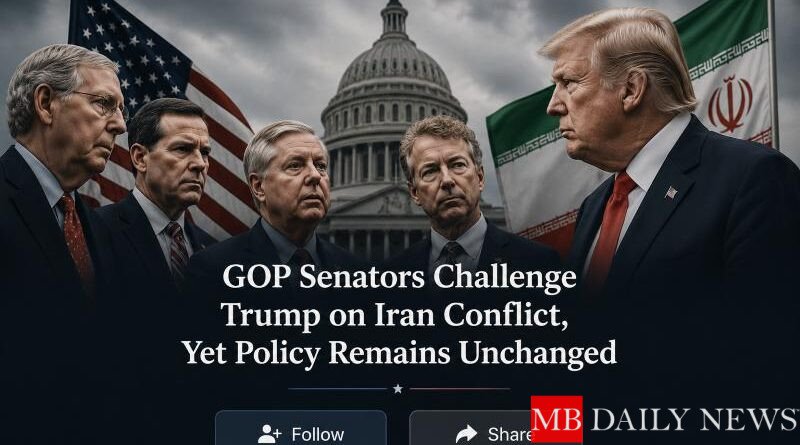
GOP Senators Challenge Trump on Iran Conflict, Yet Policy Remains Unchanged
MB DAILY NEWS | Raleigh, NC.
GOP Senators Challenge Trump: In a significant political maneuver, Senate Republicans have joined Democrats in a rare rebuke of President Trump’s war powers regarding the conflict in Iran. This bipartisan effort culminated in the passage of a war powers resolution that, while symbolically meaningful, does not alter the administration’s current military strategy in the region.
In a recent investigative report by MB Daily News, I took a closer look at the implications of this resolution and the dynamics at play within the Republican Party. While the vote marks a notable shift, it ultimately reflects the ongoing struggle among lawmakers to rein in presidential authority without enacting substantive change.
GOP Senators Challenge Trump: Republican Defections Highlight Internal Divisions
The resolution, which passed with a narrow margin of 50 to 48, saw key Republican senators, including Rand Paul, Susan Collins, Lisa Murkowski, and Bill Cassidy, break ranks with Trump. This marks a significant moment for a party often seen as unified behind the president, especially on foreign policy matters. Their support for the resolution aligns with a growing concern among some Republicans regarding the administration’s approach to Iran.
This vote comes on the heels of a similar resolution that passed in the House, showcasing a rare bipartisan coalition that has emerged in opposition to Trump’s military actions. However, the resolution lacks binding authority and will not reach the president’s desk, where it would almost certainly face a veto.
“This resolution is a statement, but it doesn’t change the reality of ongoing U.S. military involvement,” noted a political analyst familiar with the situation. In that sense, the story also echoes similar developments that have surfaced around the same issue in recent coverage, adding a wider frame to the immediate headline.
Context of the Conflict and Congressional Response
The backdrop to this legislative action is a memorandum of understanding (MOU) between the United States and Iran, which has raised concerns among lawmakers about the potential for a renewed diplomatic engagement. Many Republicans are wary of what they perceive as a repeat of the previous administration’s Iran nuclear deal, the Joint Comprehensive Plan of Action (JCPOA).
“In my view, this development matters not only for the immediate political moment, but for the wider conversation it may intensify.”
Political Stakes and the Future of U.S.-Iran Relations
The political stakes are high, as the resolution reflects not only a challenge to Trump’s authority but also a broader debate within the Republican Party about the future of U.S. foreign policy. The divisions exposed by this vote may have lasting implications as the party navigates its identity in the post-Trump era.
“What recent political coverage has shown is that similar flashpoints rarely stay contained for long.”
“The GOP needs to define its stance on foreign policy, especially as it relates to Iran,” remarked a former congressional aide, emphasizing the importance of coherence in their approach.
Broader Patterns in Congressional Dynamics
This situation is indicative of a larger trend in Congress, where increasing numbers of lawmakers are willing to challenge executive power. Recent votes have underscored a growing appetite among both parties to assert legislative authority over military engagements, particularly in the Middle East.
Implications for Political Leadership
As these tensions play out, the implications for political leadership are profound. The resolution’s passage may embolden other lawmakers to voice dissent against the administration’s policies, potentially leading to a more assertive Congress. However, without the ability to effect change through binding measures, the impact may be limited to symbolic gestures.
Looking Ahead: What This Means for Future Policy
In conclusion, while the bipartisan resolution represents a moment of significant dissent within the Republican Party, it ultimately does little to change the trajectory of U.S. policy in Iran. As negotiations continue and the political landscape evolves, the challenge for lawmakers will be to translate their concerns into actionable policy changes that reflect the will of both Congress and the American people.