

U.S. Housing Market Records Its Weakest Home Sales in 16 Years
Rising mortgage rates, elevated property prices, and declining affordability are reshaping the American real estate market. As home sales fall to their lowest levels since 2010, growing housing inventory is creating new opportunities for buyers and real estate investors.

United States | Economy & Real Estate
The U.S. real estate market is experiencing one of its most challenging periods in recent years. Existing-home sales declined significantly in October 2026, while elevated mortgage rates continued to limit purchasing power for millions of Americans.
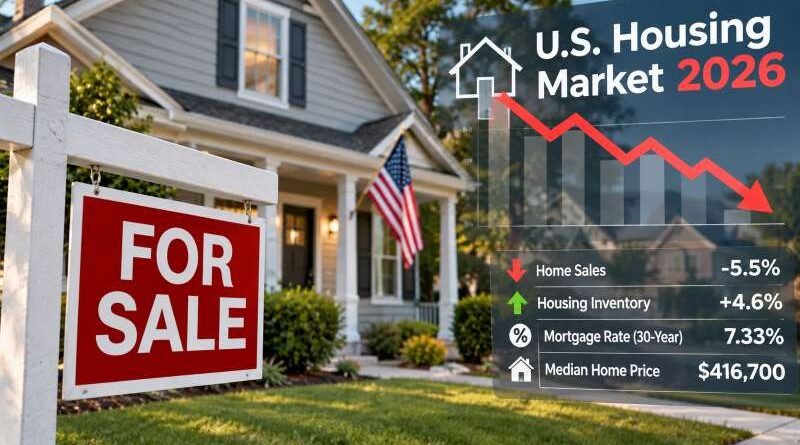
According to the National Association of Realtors (NAR), home sales fell 5.5% compared with September. Additionally, transactions declined 8.8% from the same period in 2025. These figures brought housing market activity to its lowest level since August 2010.
However, weaker sales have not triggered a nationwide collapse in property values. Instead, home prices remain relatively stable as housing inventory continues to increase. Consequently, these changing conditions are reshaping negotiations among buyers, sellers, and real estate investors.
U.S. Home Sales Reach Their Lowest Level Since 2010
The American residential real estate market recorded a seasonally adjusted annual sales rate of 3.75 million existing homes in October. This figure represents the weakest performance in more than 16 years. Furthermore, it confirms a prolonged slowdown that began when borrowing costs increased following the pandemic. For several years, annual home sales remained near four million transactions. However, the historical average is approximately 5.2 million. Therefore, the current figures demonstrate a substantial reduction in market activity. These conditions affect both mortgage-dependent buyers and homeowners considering selling their properties. Additionally, uncertainty surrounding interest rates is encouraging many households to postpone purchasing decisions.
Mortgage Rates Continue to Reduce Homebuying Affordability
High borrowing costs remain one of the greatest obstacles to a housing market recovery. During October, the average 30-year fixed mortgage rate reached 7.33%, according to Freddie Mac data cited by the NAR. One year earlier, the average stood at 6.25%. This difference significantly increases monthly mortgage payments. For example, a $300,000 mortgage could cost approximately $216 more per month compared with the previous year’s financing conditions. Consequently, many households require higher incomes to purchase comparable properties. Additionally, buyers must consider property taxes, homeowners insurance, and maintenance expenses. These factors are making homeownership increasingly difficult, particularly for first-time buyers entering the market.
Home Prices Remain Relatively Stable Despite Slower Sales
Despite declining transactions, existing-home prices continue to demonstrate resilience. During October, the national median home price reached $416,700, according to the NAR. This represented a modest annual increase of 0.4%. Although price growth remains limited, the figures indicate that weaker demand has not produced a widespread decline in property values. One explanation is that many homeowners maintain strong financial positions because of equity accumulated during previous years. Additionally, numerous property owners hold mortgages with interest rates substantially below current levels. Therefore, some prefer keeping their homes rather than selling and accepting more expensive financing. This situation reduces the pressure on sellers to lower asking prices significantly.
Rising Housing Inventory Creates New Negotiating Opportunities
One of the most important developments is the expansion of available housing inventory. At the end of October, approximately 1.59 million existing homes were listed for sale across the United States. This represented an annual increase of 4.6%. Furthermore, the available supply equaled 5.1 months of inventory at the current sales pace. Traditionally, a supply of approximately four to six months indicates a market approaching balance between buyers and sellers. Consequently, housing conditions are becoming less competitive than those experienced during previous years. Properties are also spending more time on the market. The median selling period increased to 35 days, compared with 33 days in September. These developments may provide buyers with greater opportunities to negotiate prices, repairs, and closing terms.
First-Time Homebuyers Face Increasing Financial Challenges
Americans purchasing their first homes remain among the groups most affected by housing affordability problems. During October, first-time buyers accounted for only 29% of transactions. This proportion was below the 32% recorded one year earlier. Furthermore, it remains lower than levels historically associated with a healthy residential market. Elevated property prices, mortgage rates, and down payment requirements continue to create financial barriers. As a result, many households are remaining in rental properties for longer periods. Others are considering smaller homes or neighborhoods farther from major employment centers. This trend may also influence residential demand in secondary cities and suburban communities.
Florida and the Southern United States Face a More Competitive Market
The southern United States remains one of the country’s most important residential real estate regions. During October, regional home sales declined 6.5% compared with the previous month. Additionally, transactions fell 8% from a year earlier. The median home price in the region reached $360,900, representing an annual decline of 0.4%. These figures illustrate a market increasingly sensitive to borrowing costs and broader economic conditions. In states such as Florida, buyers must also evaluate additional expenses, including homeowners insurance, property taxes, and maintenance costs. However, market conditions vary significantly between cities and neighborhoods. Therefore, understanding local property values and economic trends remains essential before making investment decisions.
Western U.S. Housing Markets Experience a Sharp Sales Decline
The western United States experienced one of the largest regional contractions in residential sales during October. Transactions declined 9.7% compared with September and 14.5% from the previous year. Meanwhile, the regional median home price reached $624,300, the highest among the nation’s four major geographic regions. These elevated property values create significant affordability challenges for middle-income households. Additionally, higher mortgage rates have a greater financial impact when buyers require larger loans. Consequently, some prospective homeowners are reconsidering their budgets and preferred locations. Others remain interested in purchasing but are approaching negotiations more cautiously. The combination of high prices and reduced transaction activity could continue influencing regional housing trends during the coming months.
Real Estate Investors Maintain an Active Presence in the Market
Although overall home sales have declined, real estate investors continue participating in residential transactions. During October, individual investors and second-home buyers accounted for 20% of purchases, compared with 16% one year earlier. Additionally, all-cash transactions represented 29% of total home sales. These figures indicate that a significant share of buyers can acquire properties without relying entirely on traditional mortgage financing. However, greater investor participation does not automatically guarantee profitability. Every acquisition requires careful consideration of rental income, property taxes, insurance, maintenance expenses, and potential resale values. Consequently, property selection and financial analysis remain essential for achieving sustainable investment returns.
Price Reductions Attract Greater Attention From Homebuyers
The housing slowdown is also changing how properties are marketed. According to Realtor.com data cited by the NAR, approximately 20.5% of active listings experienced price reductions during October. This proportion suggests that some sellers are becoming more willing to adjust their expectations. Additionally, expanding inventory allows buyers to compare more properties before submitting offers. In certain markets, these conditions may create opportunities to negotiate repairs, closing costs, and seller concessions. However, favorable purchasing conditions are not evenly distributed across the country. Well-located properties with competitive pricing and desirable features can still attract substantial interest. Therefore, asking prices should always be evaluated alongside comparable sales and the characteristics of each property.
The Rental Market Could Benefit From Homeownership Challenges
Higher mortgage costs are also influencing the American rental housing market. When households struggle to purchase homes, some decide to remain renters for longer periods. This situation may support demand for certain residential investment properties. However, rental performance depends on local factors, including employment growth, population trends, and new housing construction. Additionally, an increasing supply of apartments may limit rent growth in some metropolitan areas. Consequently, investors should not assume that rental prices will automatically increase. Sustainable returns require evaluating expected occupancy, operating expenses, property management costs, and local economic conditions.
Interest Rates Will Shape the Future of the Housing Market
Mortgage financing conditions will remain among the most important factors influencing the housing market during the coming months. A sustained decline in interest rates could encourage prospective buyers to return. Furthermore, lower borrowing costs would make previously unaffordable purchases more accessible. However, inflation and monetary policy expectations continue to influence mortgage pricing. Although the Federal Reserve does not directly establish mortgage rates, its decisions affect broader financial conditions. Therefore, homebuyers and investors will continue monitoring economic indicators. An improvement in financing conditions could stimulate accumulated housing demand. Nevertheless, a meaningful recovery will also depend on employment stability, household income growth, and residential property prices.
The U.S. Real Estate Market Enters a New Period of Challenges and Opportunities
The American housing market is undergoing a significant transformation. Existing-home sales have reached their lowest levels in more than 16 years, while property prices remain relatively stable. At the same time, expanding housing inventory is providing buyers with more alternatives. This environment presents challenges for households dependent on mortgage financing. However, it may also create opportunities for investors with available capital and strong market knowledge. The key will be identifying competitively priced properties in desirable locations with sustainable long-term investment potential. During the coming months, mortgage rates, inflation, and employment conditions will help determine the pace of recovery. Meanwhile, the United States remains one of the world’s most important real estate markets, although successful investment decisions increasingly require careful planning and a thorough understanding of local conditions.
