
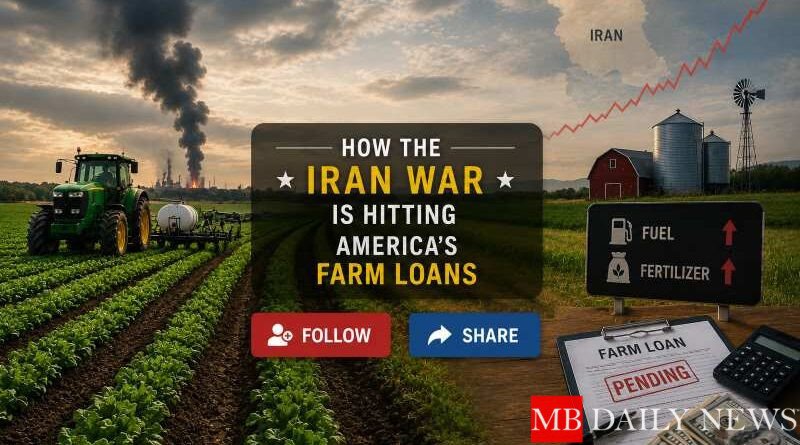
How the Iran War Is Hitting America’s Farm Loans
MB DAILY NEWS | Raleigh, NC.
American farmers are facing growing financial challenges as the ongoing conflict involving Iran sends fuel and fertilizer prices sharply higher. Agricultural lenders across the Midwest report that loan demand is increasing while repayment rates continue to decline, raising concerns about the stability of the U.S. farming sector.
The latest economic strain comes after years of trade disruptions, inflation, and export challenges that already weakened farm profitability in many rural communities.
“Farmers are cutting costs wherever possible, but many are still being forced to borrow more money just to keep operations running,” agricultural lenders said in recent industry surveys.
Fuel and Fertilizer Prices Continue to Surge
The conflict in the Middle East has intensified global energy market uncertainty, directly affecting American agriculture. Diesel fuel, transportation, and fertilizer costs have all increased significantly in recent months, creating new financial burdens for farmers preparing for planting and harvesting seasons.
Nitrogen-based fertilizers, heavily dependent on natural gas production and international supply chains, have become especially expensive.
Experts warn that higher input costs could reduce crop margins and limit profitability even if commodity prices remain stable.
“The combination of global conflict and economic uncertainty is making it harder for farmers to manage operational expenses,” financial analysts noted.
Farm Loan Demand Climbs Across the Midwest
Banks throughout agricultural regions are reporting increased demand for operating loans as farmers seek additional financing to cover rising production costs.
According to surveys from Midwestern lenders, many farmers are borrowing more money not for expansion, but simply to maintain current operations and pay for essential supplies.
At the same time, repayment rates on existing agricultural loans have weakened, signaling mounting financial pressure across rural America.
Some banks are becoming more cautious with lending standards as concerns grow about long-term farm income stability.
Tariffs and Export Challenges Continue to Hurt Farmers
The current financial pressures are adding to difficulties created by previous trade policies and export slowdowns. Many U.S. farmers continue to feel the effects of tariffs introduced during the Trump administration, which disrupted exports of soybeans, corn, and other major crops to international markets.
Reduced export demand and volatile commodity pricing have limited farm revenues over the past several years, leaving many agricultural businesses financially vulnerable.
“Many farmers entered this year already under financial stress before fuel and fertilizer costs surged again,” rural banking experts explained.
Rural Banks Face Growing Concerns
Agricultural lending is becoming a growing concern for regional and community banks that depend heavily on farm economies. Financial institutions are closely monitoring delinquency rates and loan performance as operating expenses continue rising.
Economists warn that prolonged geopolitical instability could create additional risks for both farmers and rural banking systems if production costs remain elevated through future growing seasons.
Some agricultural economists believe federal assistance programs or additional credit support may eventually become necessary if economic conditions worsen.
Farmers Continue Looking for Ways to Reduce Costs
In response to rising expenses, many farmers are reducing non-essential spending, delaying equipment purchases, renegotiating supply contracts, and seeking more efficient production strategies.
However, experts say there are limits to how much operational spending can be reduced without affecting crop yields and long-term productivity.
Farm organizations continue urging policymakers to support domestic agriculture through economic relief measures, export expansion, and fuel cost stabilization efforts.
Conclusion
The economic effects of the Iran conflict are extending far beyond global energy markets and into America’s agricultural sector. Rising fuel and fertilizer prices are increasing financial pressure on farmers already dealing with years of trade disruptions and economic uncertainty.
As loan demand rises and repayment performance weakens, banks and policymakers are watching closely for signs of deeper stress across rural communities and the broader U.S. agricultural economy.