
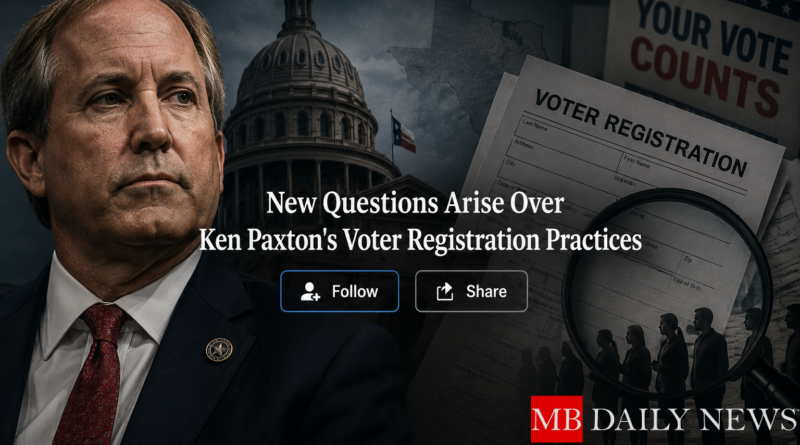
New Questions Arise Over Ken Paxton’s Voter Registration Practices
MB DAILY NEWS | Raleigh, NC.
Texas Attorney General Ken Paxton is facing renewed scrutiny over his voter registration records. The controversy comes as he seeks to strengthen his position as the Republican nominee for the U.S. Senate. As a result, the allegations have sparked fresh debate about ethics, accountability, and election integrity in Texas.
A recent investigation by MB Daily News examined the claims surrounding Paxton’s voter registration. According to the allegations, he registered to vote using an address where he did not actually live. If true, that could violate Texas law, which requires voters to register at their primary residence.
Ken Paxton’s Controversial Political Record
Paxton’s Senate campaign has unfolded against the backdrop of several legal and ethical controversies. Over the years, multiple investigations and public disputes have placed his leadership under intense scrutiny.
Moreover, several prominent Republican lawmakers have openly questioned his fitness for office. Senator Bill Cassidy of Louisiana suggested that Paxton “could reasonably be indicted for a felony.” Likewise, Senator Susan Collins of Maine described him as “an ethically challenged individual.”
These remarks are notable because they come from members of Paxton’s own party. Consequently, they highlight the growing divisions within Republican ranks over his candidacy.
In addition, Paxton’s financial records have also attracted attention. Reports indicate that he and his estranged wife identified three different homes as their primary residence in mortgage documents. Critics argue that this practice raises additional ethical concerns and further damages his credibility.
“The allegations against Paxton are not just about legality; they strike at the heart of public trust in our electoral system.”
At the same time, similar questions involving public officials have emerged in recent national coverage, placing the controversy within a broader discussion about transparency and accountability.
New Voter Registration Allegations
This week, reporting by ProPublica and The Texas Tribune alleged that Paxton voted in several elections using an address where he did not reside. The reports also claim that he used the same address during the Republican runoff election that secured his Senate nomination.
If the allegations are confirmed, they could create significant political and legal challenges for his campaign. Furthermore, the claims have drawn attention because Paxton has frequently encouraged Texans to register and vote using their legal residence.
“In my view, this development matters not only for the immediate political moment, but for the wider conversation it may intensify.”
Why the Allegations Matter
At first glance, the controversy may appear to be another political dispute. However, it carries broader implications because it involves an official who has consistently advocated for strict enforcement of election laws.
Therefore, critics argue that the allegations raise questions about consistency, public trust, and equal application of the law. Supporters, meanwhile, maintain that the claims should be fully investigated before conclusions are reached.
“What we are witnessing is a critical test of accountability for those in power, especially regarding electoral integrity.”
Political Impact on the Republican Party
The controversy could affect more than Paxton’s Senate campaign. It may also influence how Republican leaders approach one of the party’s highest-profile statewide races.
Meanwhile, divisions within the GOP have become increasingly visible. Some Republicans continue to support Paxton, while others have expressed concern that the ongoing investigations could weaken the party’s position in future elections.
As the campaign progresses, these internal disagreements may shape both fundraising efforts and voter enthusiasm.
Public Opinion and the Road Ahead
Public reaction will likely play an important role in determining Paxton’s political future. Many voters continue to place a high value on ethics and transparency, particularly when allegations involve election laws.
Consequently, the controversy could influence voter confidence as the Senate race moves forward. At the same time, the outcome of any legal or official review may further shape public opinion.
Looking Ahead
The investigation into Ken Paxton’s voter registration remains closely watched. Its outcome could affect not only his campaign for the U.S. Senate but also his long-term political future.
Ultimately, the case may become an important test of accountability in Texas politics. It also underscores the continuing debate over election integrity, public trust, and ethical standards for elected officials.