
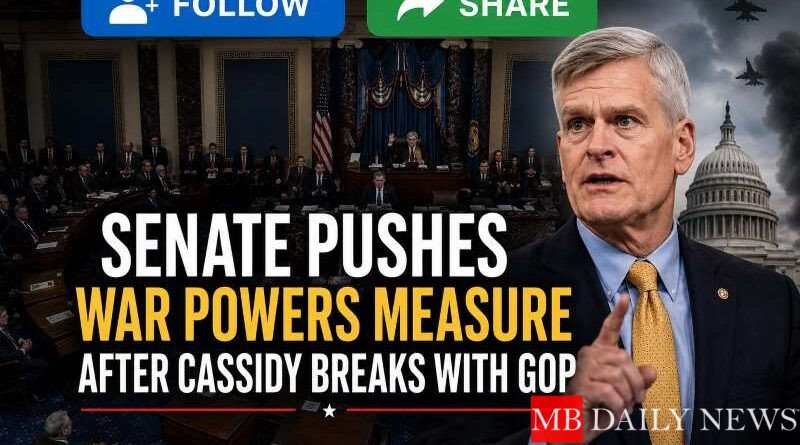
Senate Pushes War Powers Measure After Cassidy Breaks with GOP
MB DAILY NEWS | Raleigh, NC.
WASHINGTON — The U.S. Senate took a major step toward limiting President Donald Trump’s military authority after Republican Senator Bill Cassidy voted in favor of a resolution designed to restrict military action against Iran without prior congressional approval.
The procedural vote passed 50-47, signaling a significant political shift within the Republican Party and increasing pressure on the White House amid rising tensions in the Middle East.
Cassidy Changes Position After Losing Trump’s Support
Senator Bill Cassidy of Louisiana surprised Washington by supporting the measure just days after losing his Republican primary, a defeat heavily influenced by Donald Trump’s public campaign against him.
Trump openly urged Republican voters to remove Cassidy from office, escalating a political conflict that had been building for months as the senator criticized parts of the GOP leadership and expressed concerns over Trump’s military strategy toward Iran.
Before this vote, Cassidy had opposed seven previous efforts related to presidential war powers.
What the War Powers Resolution Would Do
The resolution seeks to reinforce Congress’ constitutional authority to approve any prolonged military engagement with Iran. Under the U.S. Constitution, Congress holds the exclusive power to declare war, although presidents have historically used executive authority to launch military operations without formal approval.
Supporters of the measure argue that the United States should not enter another international conflict without a full legislative debate.
Key Goals of the Resolution
- Limit unilateral military action by the president.
- Require congressional authorization for extended operations.
- Prevent further escalation with Iran.
- Restore the balance of power between Congress and the White House.
Growing Divisions Inside the Republican Party
The vote highlights deepening divisions within the Republican Party, particularly between Trump loyalists and more moderate conservatives concerned about the direction of U.S. foreign policy.
Political analysts believe Cassidy’s shift could encourage other Republicans to distance themselves from Trump following mounting internal disputes and growing criticism surrounding the Iran conflict.
National Debate Over Presidential War Powers
The debate over presidential war powers has intensified in recent years, especially after multiple military operations conducted by several administrations without a formal declaration of war.
Constitutional experts argue that Congress has gradually surrendered portions of its military authority, allowing the executive branch to take increasingly broad actions in foreign policy and national security matters.
Although the resolution still faces additional votes before becoming binding legislation, its advancement in the Senate already represents a major political signal regarding concerns over U.S. military decision-making.
Political Impact Ahead of the 2026 Elections
Cassidy’s vote could carry significant consequences for the Republican political landscape heading into the 2026 elections. While Trump continues to maintain strong influence over much of the conservative base, some lawmakers are beginning to show signs of political independence.
The measure may also open a new chapter in the ongoing debate about Congress’ role in checking presidential power during international conflicts.