
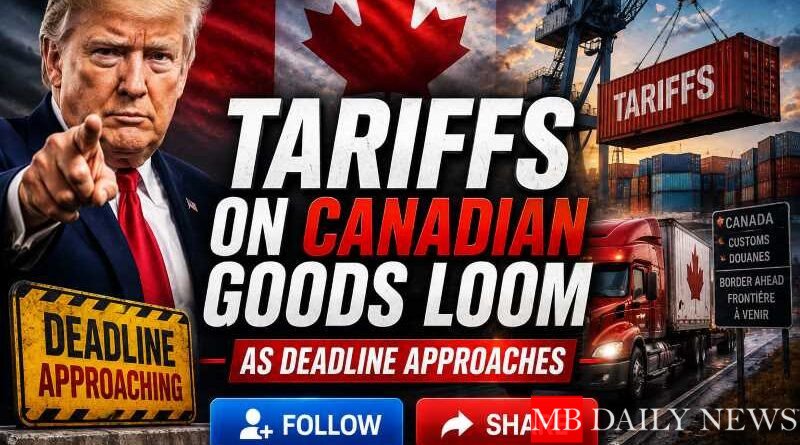
Tariffs on Canadian Goods Loom as Deadline Approaches
MB DAILY NEWS | Raleigh, NC.
Tariffs on Canadian goods: As the deadline approaches, significant tariffs on Canadian imports could soon take effect. U.S. President Donald Trump has threatened to impose new tariffs on goods from Canada. Therefore, businesses and government officials are closely watching the negotiations.
The decision could have major consequences for trade between the two countries. Meanwhile, negotiators face growing pressure to reach an agreement before the deadline. If talks fail, Washington could move forward with the tariffs.
As a result, companies on both sides of the border are preparing for possible economic disruptions. However, a last-minute agreement could still prevent further escalation.
Impact on Trade Relations
The proposed tariffs could strain trade relations between Canada and the United States. Both countries depend heavily on cross-border commerce. Therefore, any major disruption could affect numerous industries.
Canadian exporters, in particular, face uncertainty over the potential costs. At the same time, American companies that rely on Canadian products could encounter higher expenses.
Moreover, the consequences could extend beyond tariffs. Jobs, manufacturing and supply chains could also feel the effects.
Nevertheless, continued negotiations offer an opportunity to avoid a larger dispute. For this reason, businesses and officials are closely following every development.
Negotiation Challenges
Negotiators still face several difficult issues. Different economic interests and policy priorities have complicated the discussions.
Furthermore, both governments want to protect domestic industries. Each side also has specific demands, which makes compromise more difficult.
However, failure to reach an agreement could create significant financial consequences. Businesses could face higher costs, while supply chains may experience additional pressure.
Consequently, negotiators have strong incentives to continue discussions. A compromise could reduce uncertainty and help stabilize trade between the two countries.
Economic Consequences
New tariffs could increase costs for businesses and consumers. For example, Canadian products could become more expensive in the U.S. market.
As a result, some Canadian exporters could experience weaker demand. American companies that use Canadian materials may also face higher operating costs.
In addition, Canada could respond with its own trade measures. Such action could further increase tensions between the neighboring countries.
Economists often warn that prolonged trade disputes can weaken investment and economic growth. Therefore, businesses are calling for greater certainty and a quick resolution.
Moreover, industries with highly integrated supply chains could face particular challenges. Companies may need to adjust suppliers, prices or production strategies.
Political Ramifications
The dispute could also have political consequences in both countries. Leaders face pressure to defend national economic interests while preserving an important bilateral relationship.
Meanwhile, public opinion could influence how each government handles the negotiations. Businesses, workers and consumers may also pressure political leaders to avoid economic disruption.
Furthermore, tariffs could become part of broader political debates about trade and economic policy. Consequently, government decisions may influence voter sentiment.
However, leaders must balance domestic priorities with the benefits of cross-border commerce. Maintaining diplomatic communication will therefore remain important.
What’s Next for Stakeholders?
Businesses and consumers face uncertainty as the deadline approaches. Consequently, many companies are preparing contingency plans for possible tariffs.
Some businesses may adjust inventories or supply chains. Others could reconsider pricing strategies if import costs increase.
Meanwhile, consumers could eventually face higher prices if companies pass additional costs along to buyers. However, the final impact will depend on the scope and duration of any tariffs.
Therefore, stakeholders continue to support negotiations between Washington and Ottawa. Continued dialogue could help prevent a broader escalation.
The approaching deadline makes the next stage especially important. Ultimately, the decisions made by both governments will determine the immediate direction of U.S.-Canada trade.
Conclusion and Future Outlook
The potential tariffs on Canadian goods represent an important moment for North American trade. Although negotiations continue, uncertainty remains over whether both sides can reach an agreement.
Nevertheless, diplomatic talks could still produce a compromise. Such an agreement could reduce uncertainty for businesses and consumers.
On the other hand, new tariffs could increase costs and trigger additional trade measures. Therefore, the economic consequences could extend across several industries.
Furthermore, the dispute could influence future negotiations between Canada and the United States. Both countries have strong economic ties, so cooperation remains important.
Ultimately, the next decisions from Washington and Ottawa will shape the direction of their trade relationship. For now, businesses, consumers and policymakers will continue watching the negotiations closely.