
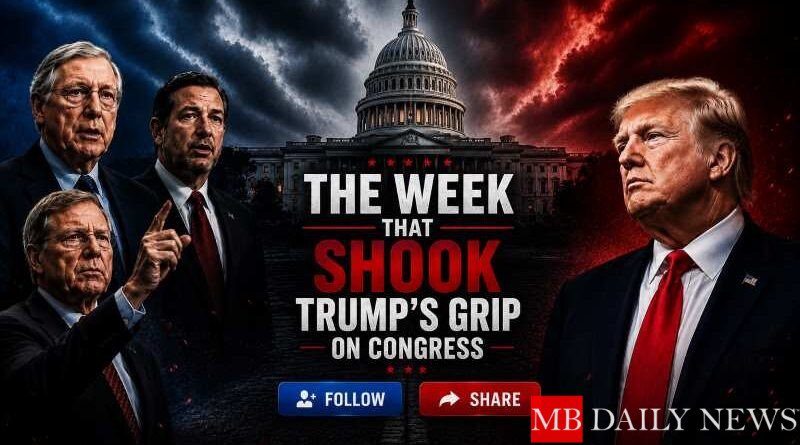
The Week That Shook Trump’s Grip on Congress
MB DAILY NEWS | Raleigh, NC.
For years, Donald Trump maintained an extraordinary level of influence over Republican lawmakers on Capitol Hill. His endorsements shaped primaries, his criticism threatened political careers, and few GOP senators openly challenged his authority. However, this week marked a rare turning point. A growing number of Republican senators pushed back publicly after controversy erupted over a Texas endorsement battle and the creation of what critics labeled a political “slush fund.”
The developments exposed deepening fractures inside the Republican Party ahead of the 2026 election cycle. More importantly, they signaled that Trump’s once ironclad control over Congress may no longer be guaranteed.
“This was the first real sign that Senate Republicans are willing to risk confronting Trump directly,” one longtime GOP strategist told MB Daily News. “That would have been almost unthinkable two years ago.”
Texas Endorsement Battle Triggered Republican Tensions
The conflict intensified after Trump intervened aggressively in a high-profile Texas Republican race. His endorsement immediately divided Senate Republicans, especially those concerned about electability and party unity.
Several GOP lawmakers privately expressed frustration that Trump’s involvement risked overshadowing broader Republican priorities. Others worried the endorsement battle could deepen ideological divisions within the party at a critical political moment.
What made the situation more explosive was the timing. Republicans are attempting to regain momentum on economic messaging, border security, and inflation concerns. Instead, internal conflict dominated headlines throughout the week.
“Republicans want to focus on defeating Democrats, not fighting civil wars,” a senior Republican aide said. “But Trump still views loyalty as the central test inside the party.”
Political analysts noted that some senators appeared increasingly comfortable distancing themselves from Trump publicly rather than limiting criticism to closed-door conversations.
Controversy Over ‘Slush Fund’ Intensified Backlash
Tensions escalated further after reports surfaced surrounding a newly created political fundraising structure critics described as a “slush fund.” Questions quickly emerged about transparency, donor influence, and how the money could shape Republican primaries.
Trump allies defended the initiative as a necessary tool to strengthen conservative candidates nationwide. Critics inside the GOP, however, argued the fund concentrated too much political power around Trump’s inner circle.
“This isn’t just about money,” one Republican senator reportedly told colleagues. “It’s about whether the party becomes fully institutionalized around one individual.”
The controversy sparked broader debate about the future direction of the Republican Party. Some lawmakers fear excessive focus on Trump-centered political operations could weaken Senate Republicans in competitive states.
Others argue Trump remains the party’s strongest political asset despite the growing internal resistance.

States Grapple with Home Equity Investment Regulation
Home equity investment regulation: As home equity investment (HEI) products gain popularity, states across the country are working to establish clearer regulatory frameworks. These products give homeowners upfront cash in exchange for a portion of their home’s future value.
Senate Republicans Show Rare Signs of Independence
Perhaps the most significant development was not the controversy itself, but the willingness of Republican senators to openly resist Trump’s pressure campaign.
Several GOP lawmakers declined to support Trump-backed positions during private caucus discussions. Others publicly criticized the strategy behind the fundraising structure and the escalating primary interventions.
That shift represents a notable change in political dynamics inside Congress.
“Trump still dominates Republican grassroots politics,” one political analyst explained. “But Senate Republicans are beginning to calculate their own political survival separately from Trump’s influence.”
The divide reflects a growing reality within the GOP. While Trump continues to command intense loyalty among many Republican voters, some elected officials increasingly fear that complete alignment with Trump could create long-term electoral risks.
The Broader Political Implications for 2026
The power struggle unfolding inside the Republican Party could carry major consequences for the 2026 elections and beyond.
Republican leadership faces mounting pressure to balance Trump’s influence with broader concerns about suburban voters, independent moderates, and battleground-state competitiveness. At the same time, Trump’s political network continues expanding its reach through endorsements, fundraising operations, and media influence.
Some strategists believe the current tensions represent only the beginning of a larger internal Republican realignment.
“This week mattered because Republicans finally tested the limits of Trump’s authority,” a former GOP campaign adviser said. “Now everyone is watching to see whether there are actual political consequences.”
Trump’s Influence Remains Powerful — But No Longer Untouchable
Despite the backlash, few analysts believe Trump’s influence over the Republican Party is disappearing anytime soon. His ability to mobilize voters, dominate media attention, and shape primary races remains unmatched in modern Republican politics.
Even so, the events of this week revealed something increasingly important: Republican resistance is no longer purely theoretical.
For the first time in months, multiple GOP senators demonstrated a willingness to publicly challenge Trump’s political machinery rather than simply accommodate it.
Whether that rebellion grows or fades may determine not only the future of Congress, but also the future identity of the Republican Party itself.