
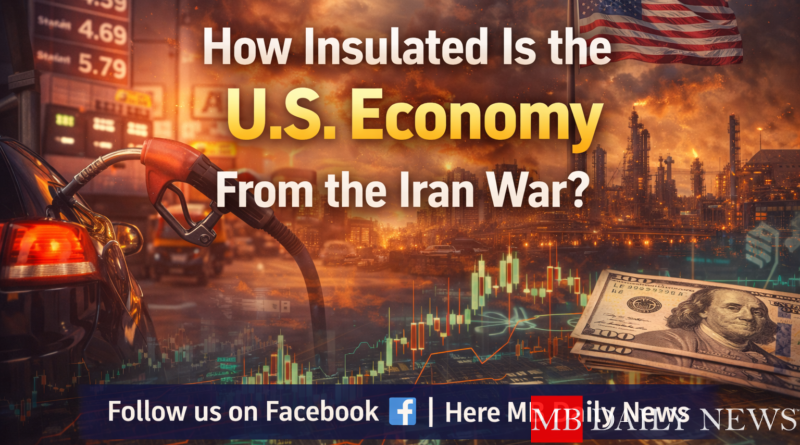
How Insulated Is the U.S. Economy From the Iran War?
April 3, 2026 | MB Daily News | Los Angeles CA

The US economy Iran war impact is becoming increasingly visible as Americans face rising gas prices, even while the broader economy shows signs of resilience compared to other parts of the world.
While global markets struggle with energy shocks and supply disruptions, the United States appears better positioned—at least for now—to withstand the economic fallout.
Why the U.S. Is Holding Up Better
The U.S. economy benefits from strong domestic energy production, making it less dependent on foreign oil than many other countries. This has helped cushion the initial blow of global supply disruptions triggered by the conflict.
Even so, fuel prices are determined globally, meaning Americans are still feeling the impact at the pump as gasoline prices climb above $4 per gallon. :contentReference[oaicite:0]{index=0}
Consumers Feel the Pressure
Rising energy costs are squeezing household budgets, particularly for lower-income families and businesses that rely heavily on transportation. Increased fuel prices are also feeding into broader inflation.
Economists estimate the conflict could add roughly 0.25 percentage points to inflation while slowing economic growth by a similar margin. :contentReference[oaicite:1]{index=1}
Strong Labor Market Offers Support
Despite rising costs, the U.S. labor market remains relatively strong. Recent data shows steady job growth and stable unemployment, helping to support consumer spending.
However, experts warn that prolonged high energy prices could eventually weaken hiring and reduce economic momentum. :contentReference[oaicite:2]{index=2}
Global Weakness Could Spill Over
While the U.S. is more insulated than many economies, it is not immune. Weakness in global markets—especially in Europe and Asia—could reduce demand for U.S. exports and slow overall growth.
Supply disruptions through the Strait of Hormuz are also affecting key materials like fertilizer and helium, which are critical for agriculture and manufacturing. :contentReference[oaicite:3]{index=3}
Rising Risks of Recession
Some economists now warn that the risk of recession has increased significantly, particularly if the conflict drags on. Prolonged energy shocks could lead to a combination of slow growth and rising inflation—known as stagflation.
Surveys show that nearly half of economists see a meaningful chance of recession if conditions worsen. :contentReference[oaicite:4]{index=4}
How Long Can the U.S. Hold Out?
The US economy Iran war impact ultimately depends on the duration of the conflict. A short war could limit long-term damage, while a prolonged crisis could strain consumers, businesses, and financial markets.
For now, the U.S. remains more resilient than many global peers—but the longer the war continues, the more that resilience will be tested.
MB Daily News 2026 Copyright – All Rights Reserved.
Follow us on Facebook | Here MB Daily News
Related Articles
- Gasoline Prices Are Rising Fast
- Investors Find Little Relief in Bonds
- Hormuz Impact on Global Markets