
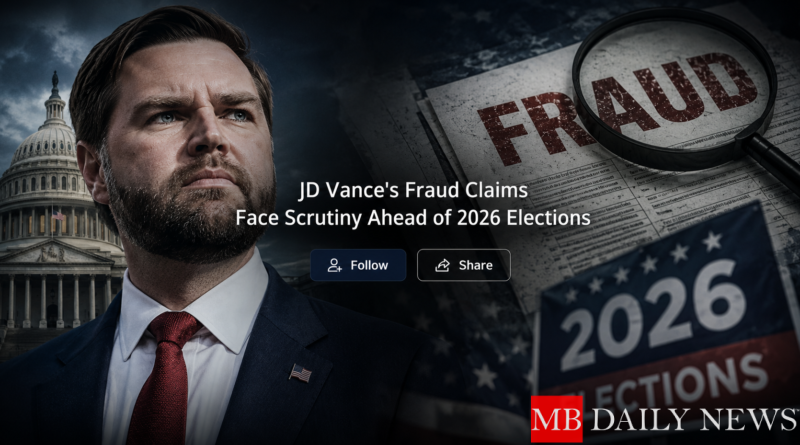
JD Vance’s Fraud Claims Face Scrutiny Ahead of 2026 Elections
MB DAILY NEWS | Raleigh, NC.
As the 2026 election season approaches, political debate is intensifying across the United States. One of the latest flashpoints involves Vice President JD Vance, who has accused Democrats of supporting fraud in social insurance programs. Although the remarks have attracted attention, they are also facing growing scrutiny from political observers and fact-checkers.
A recent investigation by MB Daily News examined Vance’s comments and the broader political context. During a speech in Wisconsin, he argued that Democrats have failed to address fraud and portrayed Republicans as the party focused on accountability. However, critics have questioned whether the allegations are supported by sufficient evidence.
JD Vance Fraud Claims Draw National Attention
Speaking to supporters, Vance asked a direct question.
“Are you going to vote for the pro-fraud party?”
The statement was intended to contrast Republican and Democratic approaches to government oversight. At the same time, analysts noted that the accusation has sparked debate because of the limited public evidence presented to support such a broad claim.
Moreover, the remarks come as both major political parties prepare for a highly competitive election cycle. Consequently, campaign messaging has become increasingly focused on issues such as government spending, public trust, and fiscal responsibility.
Why the Claims Are Being Questioned
Political experts say campaign rhetoric often becomes more aggressive before national elections. Nevertheless, they argue that strong accusations usually receive greater public scrutiny, especially when they involve allegations of fraud or misconduct.
Supporters of Vance contend that stricter oversight of public programs is necessary. Critics, however, argue that broad political claims should be supported by verifiable evidence before influencing public opinion.
“The question remains whether these claims will resonate with voters or backfire as they scrutinize the facts.”
Meanwhile, similar debates over campaign messaging and political accountability have appeared throughout recent election coverage, reflecting a broader national conversation.
A Long History of Fraud Allegations in Politics
Claims involving fraud have frequently surfaced during U.S. election campaigns. Both Republicans and Democrats have used the issue to criticize their opponents and energize supporters.
However, today’s political environment differs from previous election cycles. Voters now have greater access to fact-checking organizations and independent reporting. As a result, public figures often face faster and more detailed scrutiny when making controversial statements.
“In my view, this development matters not only for the immediate political moment, but for the wider conversation it may intensify.”
The Importance of Political Credibility
The controversy highlights a broader issue facing modern political campaigns. Public confidence often depends not only on persuasive messaging but also on the credibility of the evidence behind major claims.
Therefore, analysts say both parties face increasing pressure to support campaign arguments with verified information. Doing so may strengthen voter trust, while unsupported allegations could have the opposite effect.
“Political narratives must be grounded in truth to maintain credibility with the electorate.”
Broader Trends in Political Messaging
Vance’s comments also reflect a wider trend in American politics. Candidates from both major parties frequently accuse their opponents of ethical failures or poor governance as elections approach.
Furthermore, these exchanges have become more common in recent years as campaigns rely heavily on media coverage and social platforms to reach voters. Consequently, political messaging often becomes more polarized during national election seasons.
What Could This Mean for the 2026 Elections?
The political impact of Vance’s remarks will likely depend on how voters respond in the months ahead. If the allegations are viewed as credible, they could reinforce Republican campaign messages centered on government accountability.
On the other hand, if voters conclude that the claims lack sufficient evidence, the strategy could weaken its effectiveness. Ultimately, the debate illustrates how trust, credibility, and factual accuracy continue to play a central role in American elections.
As the campaign moves forward, both parties are expected to intensify their messaging. For many voters, however, the deciding factor may be whether political arguments are supported by clear evidence rather than campaign rhetoric alone.