
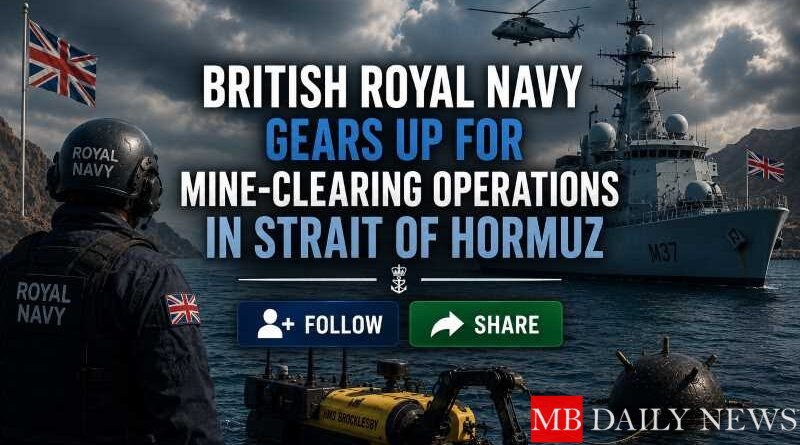
British Royal Navy Gears Up for Mine-Clearing Operations in Strait of Hormuz
MB DAILY NEWS | Raleigh, NC.
British Royal Navy mine-clearing: The British Royal Navy is preparing for operations in the Strait of Hormuz, one of the world’s most important oil shipping routes. As tensions rise in the region, British officials are highlighting their advanced military capabilities. They also stress the need for international cooperation to protect maritime security.
In a recent investigative report for MB Daily News, I examined the impact of Britain’s military readiness. British forces stationed in Gibraltar are preparing to deploy mini submarines and specialized mine-clearing equipment. Officials say operations will begin only after the United States and Iran reach a diplomatic agreement to end current hostilities.
Military Readiness and International Cooperation
During a media briefing aboard the RFA Lyme Bay, Britain’s armed forces minister, Al Carns, emphasized NATO cooperation. More than 40 countries continue to feel the effects of the regional energy crisis. As a result, pressure is growing to secure safe navigation through the Strait of Hormuz.
“I would always say the Royal Navy is the best in the world,” Carns said while sailors prepared equipment for possible deployment.
His comments reflected national confidence and highlighted the Royal Navy’s role in protecting maritime stability during periods of geopolitical uncertainty.
Geopolitical Context and Risks
The political backdrop remains highly complex.
Britain’s possible involvement in mine-clearing operations has raised concerns about the safety of British service members. Many European allies remain cautious after previous U.S. military actions in the region that lacked broad international consultation. That history still influences political tensions across Europe.
“In my view, this development matters not only for the immediate political moment, but also for the broader international debate it could intensify.”
“Risking the lives of British service members in a conflict launched without strong allied coordination remains politically sensitive in both the U.K. and Europe.”
Recent security developments across the region have reinforced these concerns and placed Britain’s preparations in a wider geopolitical context.
Potential Impact on Regional Stability
The Strait of Hormuz handles roughly 20% of the world’s oil supply. Any disruption to shipping through the strait could quickly affect global energy markets. It could also increase international tensions.
The Royal Navy’s readiness sends a strong message about Britain’s commitment to protecting maritime trade routes. At the same time, it highlights the fragile state of international relations in an already unstable region.
Broader Trends in Global Security
The situation in the Strait of Hormuz reflects a larger global trend. Military preparedness now depends heavily on diplomatic progress. Countries must balance defense strategies with negotiations as geopolitical uncertainty grows.
The connection between military capability and diplomacy has become increasingly important for maintaining regional and global stability.
Human and Political Stakes
The potential deployment of British forces involves more than military strategy. It also carries major political and human consequences inside the U.K.
Public opinion remains cautious about foreign military involvement. Many people oppose conflicts that lack broad international support. British leaders must balance these concerns against the need to protect freedom of navigation and global trade routes.
Looking Ahead
The evolving situation in the Strait of Hormuz may become a major test of U.K. foreign policy and its commitment to NATO allies. Diplomatic negotiations continue, but the Royal Navy’s preparations show Britain’s willingness to respond if necessary.
The timing and conditions of any operation will be critical. Global observers will continue watching developments closely because the outcome could affect energy security, regional stability, and international relations for years to come.