
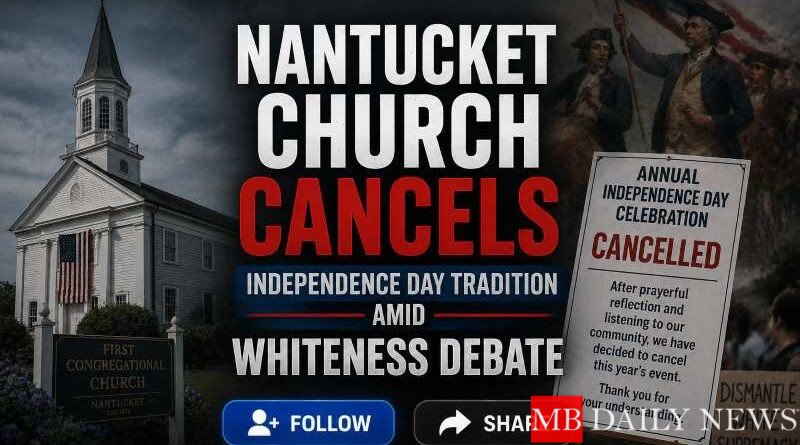
Nantucket Church Cancels Independence Day Tradition Amid Whiteness Debate
MB DAILY NEWS | Raleigh, NC.
A historic church on Nantucket Island, a popular retreat destination for former President Joe Biden, has sparked controversy after canceling its annual Fourth of July reading of America’s founding documents. Church leaders said the decision was part of an effort to examine “our own whiteness.” As a result, the move triggered strong reactions from conservative commentators and local residents.
In a recent investigative report for MB Daily News, I examined the implications of this decision. The controversy reflects broader tensions surrounding race, privilege, and the way Americans commemorate the nation’s founding ideals. The Nantucket Unitarian Universalists (NUU), led by Rev. Erin Splaine, announced the cancellation in a letter to the community. Shortly afterward, criticism spread rapidly across social media platforms.
Fourth of July Tradition Canceled: Cancellation Sparks Outrage
For 25 years, the congregation hosted an annual reading of the Declaration of Independence and the Bill of Rights. However, church leaders decided to pause the event this year. According to their statement, the cancellation is part of an ongoing effort to address issues of race and privilege within the congregation.
“Our cancelling the 4th of July celebration this year reflects an ongoing process within the congregation to better understand our own whiteness,” church leaders explained.
Nevertheless, many critics rejected that reasoning. Conservatives, in particular, viewed the decision as an attack on American traditions. They argue that canceling the event diminishes the significance of Independence Day and the values associated with it. Consequently, the backlash has highlighted a growing divide over how the nation’s history should be remembered and celebrated.
“This is a misguided attempt to address complex issues by erasing our history,” one local commentator said.
Context of the Debate
The controversy comes as communities across the country prepare for America’s upcoming semiquincentennial celebration. At the same time, discussions about race, privilege, and historical memory continue to intensify. Therefore, the Nantucket church’s decision has become a symbol of a larger cultural debate.
Many Americans are now questioning long-standing narratives that have shaped national identity.
“In my view, this development matters not only for the immediate political moment but also for the broader conversation it may intensify.”
Why This Matters
The cancellation extends beyond a local dispute. Instead, it reflects a broader shift in how institutions approach race, history, and public memory. Church leaders believe the decision can encourage a more inclusive discussion about the unequal application of rights and privileges throughout American history.
However, critics fear that such efforts could weaken the cultural traditions and historical symbols that unite communities.
“We must confront our past to build a better future,” a local activist remarked while emphasizing the importance of continued dialogue.
Meanwhile, recent political controversies suggest that similar debates rarely remain confined to a single community.
Broader Implications
The situation mirrors developments in other parts of the country. Increasingly, institutions are reassessing their roles in addressing systemic inequalities. From school curricula to public commemorations, organizations are facing growing pressure to balance recognition of historical injustices with respect for America’s founding principles.
As a result, debates over national identity and historical interpretation have become central issues in public discourse.
Impact on Community Relations
The church’s decision may deepen divisions within the Nantucket community. Some residents feel alienated by the cancellation. Others, however, view it as a necessary step toward greater awareness and understanding.
Ultimately, the challenge lies in balancing long-standing traditions with evolving perspectives on American history and identity.
Looking Ahead
As the United States approaches major historical milestones, the Nantucket church’s decision serves as a reminder of the ongoing effort to reconcile the nation’s ideals with its realities. Furthermore, the controversy may signal a broader trend among institutions seeking to reevaluate their role in shaping public memory.
The outcome of this debate could influence how similar events are handled across the country in the years ahead.