

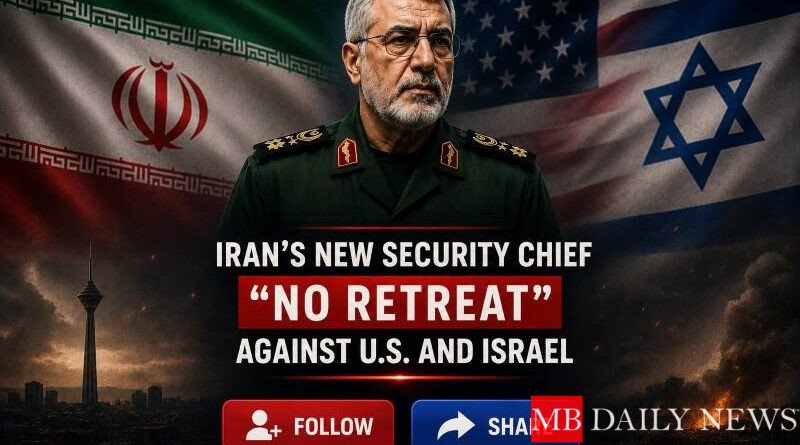
Iran’s New Security Chief Warns There Will Be “No Retreat” Against U.S. and Israel
MB DAILY NEWS | Raleigh, NC.
Iran’s newly appointed Supreme National Security Council chief, Mohammad Bagher Zolghadr, declared that the Islamic Republic will not retreat in its confrontation with the United States and Israel, marking a hardline tone in his first public message to the Iranian people.
Speaking through the semi-official Tasnim News Agency, Zolghadr praised Iran’s military, diplomats, and civilians for their resistance against foreign pressure and regional adversaries.
“There will be no retreat,” Zolghadr stated, adding that Iran’s military forces and public resistance had “put the enemy on its knees.”
The comments reflect Tehran’s increasingly aggressive rhetoric amid heightened tensions across the Middle East following months of regional conflict and military escalation.
Who Is Mohammad Bagher Zolghadr?
Mohammad Bagher Zolghadr is a veteran figure within Iran’s political and military establishment. Before becoming head of the Supreme National Security Council, he served as deputy commander of the Islamic Revolutionary Guard Corps (IRGC), one of the country’s most influential military organizations.
His appointment came after the death of former council chief Ali Larijani, who reportedly died during an Israeli strike earlier this year.
Political analysts say Zolghadr’s rise signals a growing consolidation of power by the IRGC inside Iran’s leadership structure.
According to regional observers, the Revolutionary Guard has expanded its influence over Iran’s foreign policy, military strategy, and domestic security since the outbreak of recent regional conflicts.
Iran Calls for National Unity
In addition to his warning toward the United States and Israel, Zolghadr urged Iranians to remain united during what he described as a critical period for the country.
“Unity and cohesion are themselves another battlefield in the struggle,” he said.
He warned against internal divisions and emphasized that collective solidarity would be essential for Iran to overcome external pressure and regional challenges.
“A collective effort to avoid divisive words or actions will lead beloved Iran to final victory, God willing,” he added.
The statement appears aimed at strengthening domestic support as Iran faces growing economic hardship, international sanctions, and rising geopolitical tensions.
Escalating Tensions Between Iran, Israel, and the United States
Relations between Iran, Israel, and the United States have deteriorated sharply in recent years, fueled by disputes over Iran’s nuclear program, regional proxy groups, and military operations across the Middle East.
Israel has repeatedly accused Iran of financing and arming militant organizations in Lebanon, Syria, Iraq, and Gaza, while Tehran insists it is defending regional allies and resisting Western influence.
The United States has also maintained heavy sanctions on Iran and increased military cooperation with Israel and Gulf allies.
Security experts warn that hardline statements from senior Iranian officials could further inflame an already volatile situation in the region.
Why Zolghadr’s Appointment Matters
Analysts believe Zolghadr’s leadership could indicate a tougher Iranian security doctrine moving forward.
His deep ties to the IRGC suggest Tehran may prioritize military deterrence and strategic confrontation rather than diplomatic compromise.
The Supreme National Security Council plays a central role in shaping Iran’s defense policies, nuclear negotiations, and regional strategy, making the position one of the most powerful in the country’s political system.
Experts say the appointment demonstrates how Iran’s leadership is preparing for prolonged regional instability and potential future confrontations with Israel and Western powers.
International Reaction and Regional Concerns
Western governments and Middle East observers are closely monitoring Iran’s internal political shifts and military rhetoric.
Diplomatic efforts to reduce tensions in the region remain fragile, especially as conflicts involving Iran-backed groups continue in multiple countries.
International analysts warn that increasingly confrontational language from Tehran could complicate negotiations over regional security and nuclear diplomacy.
Despite international pressure, Iranian officials continue to insist that the country will defend its sovereignty and strategic interests under any circumstances.