
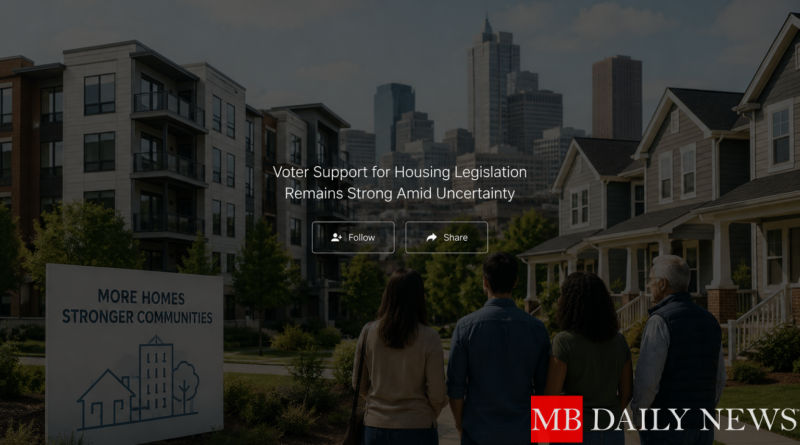
Voter Support for Housing Legislation Remains Strong Amid Uncertainty
MB DAILY NEWS | Raleigh, NC.
The future of the 21st Century ROAD to Housing Act remains uncertain. However, a new poll shows strong public support for its main provisions. About 90% of voters favor the legislation, which aims to increase affordable housing across the United States. Even with this overwhelming backing, the bill now awaits a decision from President Donald Trump after clearing Congress.
A recent investigation by MB Daily News examined the bill’s legislative path and the public response. The bipartisan proposal has gained support from lawmakers and voters alike. Nevertheless, its future remains unclear, raising new questions about the administration’s priorities and its approach to housing policy.
Support for the ROAD Act: Legislative Journey and Current Status
The ROAD Act is designed to expand the supply of affordable housing nationwide. Speaker Mike Johnson (R-LA) returned the legislation to the White House on June 29, beginning a 10-day window for presidential action. As a result, the deadline falls on July 10.
Before reaching the President’s desk, the bill received broad bipartisan backing. It passed the Senate and later cleared the House of Representatives by a decisive 358-32 vote.
Despite this strong support, President Trump has not yet signed the legislation. Instead, he has indicated that Congress should first address the SAVE America Act, a measure focused on strengthening voter identification requirements. Consequently, housing advocates worry that further delays could slow efforts to address the nation’s housing shortage.
“The ROAD Act represents a critical opportunity to address the housing shortage; delaying its passage could have real consequences for countless families,” an industry expert noted.
At the same time, similar developments have appeared in recent national reporting. These parallel stories suggest the debate reflects broader political and policy trends rather than an isolated legislative dispute.
Public Sentiment Shows Broad Bipartisan Support
A poll conducted by the American Property Owners Alliance surveyed 800 registered voters. The results revealed strong bipartisan support for the ROAD Act. Participants reviewed five major objectives of the legislation, and each received favorable responses across political affiliations.
Moreover, respondents recognized the need to increase affordable housing. Many also expressed support for policies that encourage new housing development and improve access for working families.
“In my reporting, this development appears more consequential once it is placed alongside similar national tensions.”
Why Delays Could Matter
The consequences of delaying the ROAD Act extend well beyond Washington. Housing prices continue to rise, while affordability remains a challenge for millions of Americans. Therefore, many voters believe lawmakers should move quickly to address the issue.
Furthermore, the gap between public opinion and political negotiations has become increasingly noticeable. Many observers argue that elected officials must respond more directly to the concerns of voters.
“What recent public affairs coverage has shown is that comparable developments rarely fade at the level where they begin.”
A political analyst emphasized the urgency of the issue.
“Public support for housing initiatives like the ROAD Act indicates a pressing need for government to act decisively.”
Comparing the ROAD Act With Other Priorities
Although the ROAD Act has received widespread support, it competes for attention with other legislative priorities. One example is the SAVE America Act, which remains a major focus for President Trump despite receiving less public enthusiasm.
As a result, some analysts see a growing disconnect between voter priorities and the administration’s legislative agenda. This contrast also highlights broader national debates over housing policy, election laws, and competing policy objectives.
What This Means for Housing Policy
The uncertainty surrounding the ROAD Act raises important questions about the future of affordable housing in the United States. As housing costs continue to increase, public pressure on lawmakers is also growing.
In addition, failure to approve the legislation could signal a broader pattern in which urgent housing challenges receive less attention than other political issues. Such an outcome could influence future debates over housing policy and government accountability.
What Happens Next?
The July 10 deadline represents a critical moment for the White House and for Congress. President Trump’s decision will determine whether the ROAD Act becomes law or faces additional delays.
Ultimately, the outcome will shape more than affordable housing policy. It may also affect public confidence in government leadership and demonstrate how closely the administration’s actions align with the priorities of American voters.