

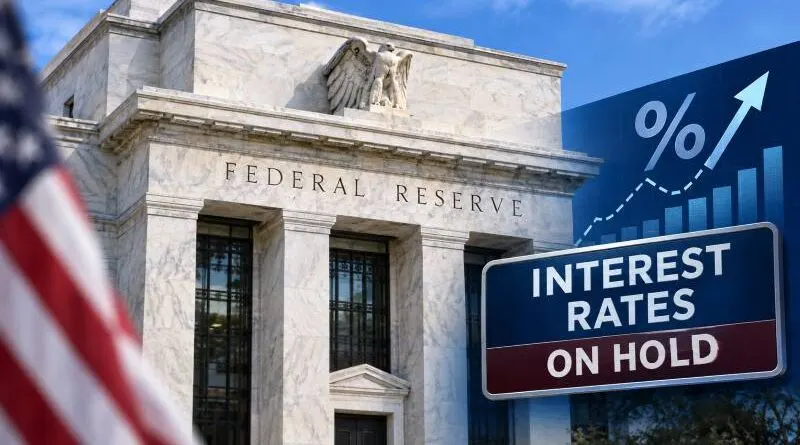
Federal Reserve Holds Interest Rates Steady as Expectations of Tighter Monetary Policy Grow
Federal Reserve deliberations reveal a cautious stance among policymakers, who believe persistent inflationary pressures and evolving U.S. economic conditions could justify keeping interest rates elevated for an extended period.
U.S. monetary policy continues to navigate a period of uncertainty, shaped by inflation expectations, labor market developments, and the broader outlook for economic growth.
During last month’s meeting, Federal Reserve (Fed) officials decided to leave interest rates unchanged. However, their discussions suggested that borrowing costs may need to remain elevated or potentially rise further if economic conditions warrant additional monetary tightening.
Inflation Continues to Shape Monetary Policy Decisions
One of the Federal Reserve’s most significant challenges remains ensuring that inflation moves sustainably toward its 2% target.
Although maintaining current interest rates provides policymakers with additional time to assess economic indicators, the decision does not necessarily signal the beginning of a more accommodative monetary policy.
Persistent price pressures could compel officials to extend restrictive financial conditions, particularly if domestic demand and consumer spending remain stronger than anticipated.
Higher Interest Rates and Their Impact on the Economy
Federal Reserve decisions carry implications far beyond the U.S. banking system. Their influence extends to corporate lending, mortgage financing, equity markets, and international capital flows.
A prolonged period of elevated interest rates can increase borrowing costs, discourage certain investments, and raise the return expectations associated with new business ventures and development projects.
Conversely, a disciplined monetary policy also seeks to preserve price stability, reinforce investor confidence, and prevent long-term economic imbalances.
Real Estate Markets Face the Challenges of Higher Financing Costs
The real estate industry remains among the sectors most sensitive to fluctuations in interest rates.
When mortgage financing costs remain elevated, prospective homebuyers may face higher monthly payments, while property developers must account for more demanding financing conditions when undertaking new projects.
This environment can also reshape investment strategies, increasing the appeal of income-producing properties, established locations, and real estate assets with sustainable long-term appreciation potential.
For Latin American markets, Federal Reserve decisions serve as an important economic benchmark because of their influence on the U.S. dollar, international credit conditions, and cross-border investment flows.
Investors Closely Monitor Upcoming Federal Reserve Decisions
Financial market expectations will remain closely tied to upcoming reports on inflation, employment, business activity, and consumer spending.
The Federal Reserve must strike a delicate balance between containing inflationary pressures and preventing excessively restrictive monetary conditions from undermining economic activity.
Consequently, the future direction of interest rates will depend on both the performance of key economic indicators and policymakers’ assessment of emerging financial and economic risks.
Federal Reserve Minutes Reveal a More Hawkish Policy Outlook
According to a report published by The Wall Street Journal, minutes from the October 27–28 meeting indicated that nearly all participants anticipated the need for additional interest rate increases.
Some officials reportedly believed that raising rates during that meeting would have been appropriate. Others supported maintaining the existing policy stance, although they acknowledged that the decision was a close call.
These deliberations highlight growing concerns within the Federal Reserve about persistent inflation and the potential need for a more assertive monetary policy response.
December Emerges as a Critical Turning Point for Monetary Policy
Economic data released following the meeting have reinforced expectations of another monetary policy adjustment. October’s employment growth and persistent core inflation have increased pressure on policymakers to consider additional measures.
Investors are now anticipating a potential interest rate increase in December, while some monetary authorities have raised the possibility of more substantial adjustments.
Nevertheless, fluctuations in oil prices and volatility in technology stocks could influence the economic outlook and ultimately affect the timing and magnitude of future policy decisions.
As the Federal Reserve approaches its next policy meeting, financial markets, businesses, and investors will closely examine incoming economic indicators for clearer signals about the direction of U.S. monetary policy.
The outcome could have significant consequences for borrowing costs, investment strategies, real estate activity, and global financial conditions in the months ahead.