
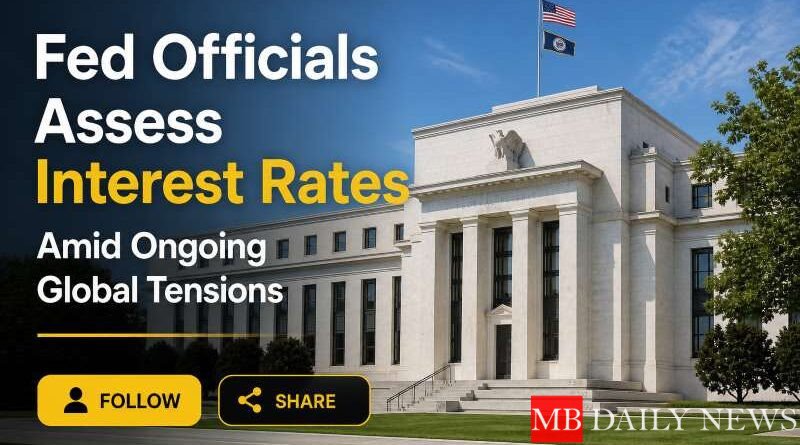
Fed Officials Assess Interest Rates Amid Ongoing Global Tensions
MB DAILY NEWS | Raleigh, NC.
Federal Reserve Interest Rates
The Federal Reserve faces a critical moment. John Williams, president of the New York Fed, recently explained its current strategy. The central bank aims to balance price stability with full employment.
This situation follows recent supply chain disruptions. These disruptions are linked to geopolitical tensions, especially the conflict in Iran.
In a recent investigative report by MB Daily News, I examined how these global events affect Fed policy. I also explored what this means for the economy and investors.
Current Economic Landscape
Williams highlighted the complexity of today’s economy. The conflict has created uncertainty around inflation and employment.
As a result, the Fed is taking a cautious approach. It is adjusting interest rates carefully to avoid sudden shocks.
Moreover, this strategy reflects a broader reality. Global events now have a direct impact on domestic economic conditions.
At the same time, inflation remains a key concern. Therefore, the Fed must act carefully while protecting job growth.
Williams emphasized this point: “The Fed must remain vigilant in addressing both inflation and employment challenges.”
Impact of Supply Chain Disruptions
Ongoing conflict continues to disrupt global supply chains. Consequently, several sectors may face delays and rising costs.
These disruptions can increase inflationary pressure. In addition, they complicate the Fed’s efforts to stabilize the economy.
Furthermore, uncertainty around trade routes and commodity prices persists. This raises concerns about long-term economic stability and consumer confidence.
Implications for Investors
For investors, the Fed’s stance signals potential market volatility. As conditions change, traders expect possible policy adjustments.
Therefore, markets remain highly sensitive to new data. Even small signals from the Fed can trigger strong reactions.
In this context, interest rates continue to shape investor sentiment. This relationship becomes even more important during uncertain periods.
Geopolitical Context and Market Reactions
At the same time, geopolitical tensions play a major role. They influence both economic forecasts and policy decisions.
Historically, major global events have shifted monetary policy. The current situation follows a similar pattern.
As a result, markets react quickly to new developments. Traders constantly adjust expectations based on global news.
Social and Economic Impact
The Fed’s decisions affect more than financial markets. They directly impact households and businesses.
For example, inflation influences daily expenses. At the same time, interest rates affect borrowing and job stability.
Because of this, public confidence depends on the Fed’s actions. Stability in prices and employment remains essential.
Looking Ahead
The path forward remains uncertain. The Fed will continue to monitor both global and domestic conditions.
Meanwhile, investors, businesses, and consumers must stay alert. Policy changes may come as new data emerges.
Ultimately, the interaction between geopolitics and economics will shape future decisions. Therefore, adaptability will be key in the months ahead.