
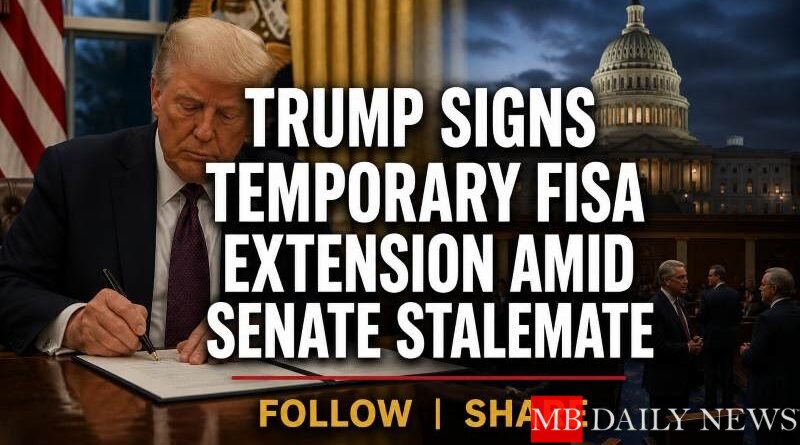
Trump Signs Temporary FISA Extension Amid Senate Stalemate
MB DAILY NEWS | Raleigh, NC.
In a significant move reflecting ongoing tensions in national security policy, President Donald Trump signed a 45-day extension of Section 702 of the Foreign Intelligence Surveillance Act (FISA). However, this decision came after the Senate rejected a longer three-year renewal that had bipartisan support in the House. As a result, the short-term extension highlights the ongoing struggle to balance national security with civil liberties.
In a recent investigative report by MB Daily News, I examined both the implications of this decision and the political maneuvering behind it. Earlier this week, Senate Majority Leader John Thune warned House leaders about a potential obstacle. Specifically, he said that including a ban on central bank digital currencies (CBDC) in the FISA extension would cause it to fail in the Senate. Indeed, his prediction proved accurate. The longer extension was blocked, largely due to Democratic opposition.
Senate Dynamics and the FISA Debate
Meanwhile, the Senate’s unanimous consent to approve a temporary extension reflects a broader trend of legislative gridlock. On one hand, FISA allows the government to access communications of foreign targets. On the other hand, it remains highly controversial.
Critics argue that the law infringes on Americans’ privacy rights and may violate the Fourth Amendment. In contrast, supporters—including law enforcement and intelligence officials—believe FISA is essential. They argue it helps combat threats such as terrorism and cybercrime.
Overall, this latest episode shows how divisive national security legislation has become in today’s political climate.
“We should all be standing up for the Fourth Amendment,” one critic stated, stressing the need to protect privacy rights.
Political Fallout and Future Implications
As the 45-day deadline approaches, Congress faces a difficult challenge. Lawmakers must revisit the FISA renewal process once again. This time, however, they must deal with both legal complexities and political divisions.
Notably, more than 20 Republicans opposed the extension, even with the CBDC ban included. Consequently, this reveals deep divisions within the party. It also raises concerns about the future of bipartisan cooperation on national security.
“In my view, this development matters not only for the immediate political moment, but for the wider conversation it may intensify.”
The Bigger Picture: Privacy vs. Security
More broadly, the FISA debate reflects a larger national conversation. At its core, it is about privacy versus security. As technology evolves, surveillance methods continue to expand. Therefore, concerns about government overreach are growing.
Civil liberties advocates are pushing for stronger protections. They argue that laws like FISA must evolve to safeguard individual rights in the digital age.
“What recent political coverage has shown is that similar flashpoints rarely stay contained for long.”
At the same time, others emphasize the need for balance.
“The balance between security and privacy must be carefully maintained,” noted one advocate.
Broader Legislative Trends
Furthermore, this situation is not unique. Instead, it reflects a broader pattern of conflict in Congress. Increasingly, issues involving technology, finance, and privacy are becoming political battlegrounds.
Because of this, the failure to pass a long-term FISA renewal may signal a shift. In particular, lawmakers may begin to scrutinize surveillance practices more closely in future sessions.
Impacts on Law Enforcement and Intelligence Agencies
At the same time, the temporary extension has practical consequences. Law enforcement and intelligence agencies depend on FISA to monitor potential threats. Without it, their effectiveness could be reduced.
Therefore, lawmakers face a difficult balancing act. They must protect national security while also preserving fundamental rights.
What Lies Ahead
Looking ahead, the situation remains uncertain. With the extension set to expire soon, further debate—and possibly conflict—is likely. If Congress fails to reach a long-term agreement, the consequences could be significant.
Not only could national security operations be affected, but public scrutiny may also increase. Advocacy groups are already paying close attention. Ultimately, the outcome of this debate could shape the future of surveillance laws in the United States.