
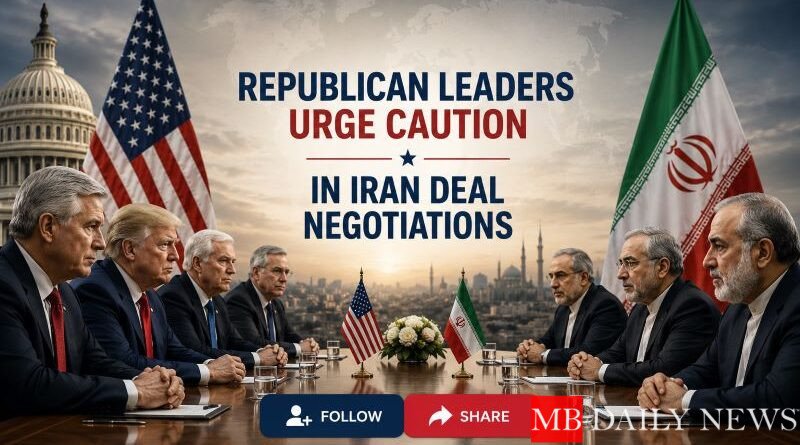
Republican Leaders Urge Caution in Iran Deal Negotiations
MB DAILY NEWS | Raleigh, NC.
A prominent Republican senator is urging President Trump to rethink the administration’s approach to ongoing negotiations with Iran. As talks reportedly advance, Sen. Roger Wicker of Mississippi has issued a strong warning against what he considers a weak deal with Tehran.
Wicker serves as chairman of the Senate Armed Services Committee. His comments reflect growing concern among Republicans about the future of U.S.-Iran relations and the direction of American foreign policy.
Wicker Warns Against Diplomatic Concessions
In a recent investigative report by MB Daily News, tensions within Republican circles became increasingly visible. According to Wicker, the administration risks sending the wrong message if it pursues a diplomatic agreement that reduces pressure on Iran.
“We are at a moment that will define President Trump’s legacy,” Wicker said.
He also argued that the president should avoid signing a deal that lacks long-term enforcement or strategic value.
“His instincts have been to finish the job he started in Iran,” Wicker stated. “However, he is being ill advised to pursue a deal that would not be worth the paper it is written on.”
As a result, the senator called on the administration to maintain military pressure rather than prioritize diplomacy.
Republicans Fear Perception of Weakness
Many Republicans share Wicker’s concerns. They believe that any major concession to Iran could damage U.S. credibility and encourage hostile governments.
According to Wicker, “further pursuit of an agreement with Iran’s Islamist regime risks a perception of weakness.”
Because of this, several party leaders are pushing for a stronger military posture in the region. They argue that maintaining strategic pressure is essential for national security.
“We must finish what we started,” Wicker added. “It is past time for action.”
Rubio Says Negotiations Show Limited Progress
Meanwhile, Secretary of State Marco Rubio acknowledged that negotiations have shown some progress. However, he warned against assuming that a final agreement is close.
“There’s been some progress,” Rubio explained.
At the same time, Rubio emphasized that discussions remain complicated and unresolved. His cautious tone highlights the uncertainty surrounding the talks.
Diplomacy vs. Military Strategy
The debate has exposed a deeper divide over U.S. foreign policy strategy. Some officials believe diplomacy could reduce tensions and create stability in the Middle East.
Others disagree.
Critics argue that easing pressure on Iran could weaken American influence and undo previous military gains.
“It’s essential that we maintain our strategic advantage,” one political analyst noted.
Therefore, the administration now faces a difficult balancing act between diplomacy and deterrence.
Broader Impact on U.S. Foreign Policy
The Iran negotiations may also affect America’s relationships with allies and adversaries around the world.
For Republicans like Wicker, the issue goes beyond Iran itself. Instead, they see it as a test of U.S. resolve and leadership on the global stage.
In that sense, the debate reflects broader ideological divisions inside the Republican Party about how America should project power abroad.
What Comes Next?
As negotiations continue, the Trump administration faces major decisions that could shape its foreign policy legacy for years.
Supporters of diplomacy hope an agreement could prevent future conflict. Meanwhile, critics insist that military strength remains the best way to contain Iran’s influence.
Ultimately, the coming weeks may determine the future of U.S.-Iran relations and America’s role in the Middle East.