
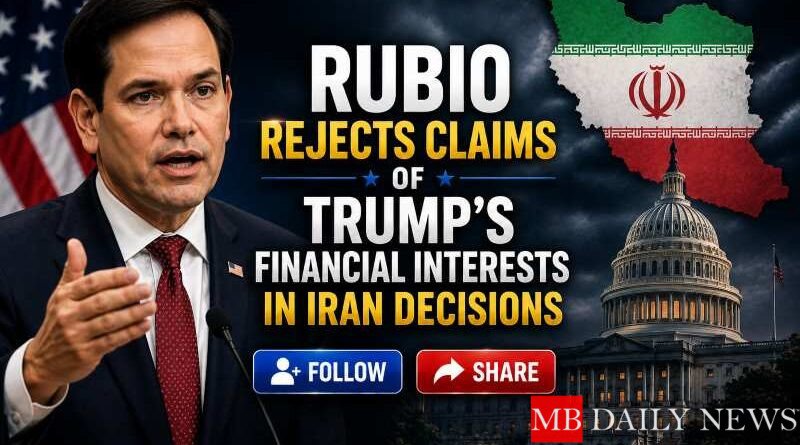
Rubio Rejects Claims of Trump’s Financial Interests in Iran Decisions
MB DAILY NEWS | Raleigh, NC.
During a House Foreign Affairs Committee hearing, Secretary of State Marco Rubio strongly rejected allegations that President Donald Trump’s financial interests influenced decisions related to Iran.
The exchange highlighted ongoing debates about transparency, ethics, and national security. It also renewed questions about whether personal financial holdings could affect foreign policy decisions.
In a recent report for MB Daily News, I examined the broader implications of Rubio’s remarks and the continuing scrutiny surrounding financial disclosures among public officials.
Trump Financial Interests in Iran: Rubio Issues Firm Denial
Representative Gregory Meeks of New York raised concerns about potential conflicts of interest. Specifically, he questioned whether Trump’s personal financial situation played any role in military decisions involving Iran.
Rubio responded immediately and forcefully.
“Not once. Just to be clear, not a single time, not even for a millisecond,” Rubio said.
He stressed that he has participated in numerous foreign policy meetings with the president. Furthermore, he stated that Trump never discussed personal financial interests when considering military action or foreign policy matters.
As a result, the exchange drew attention to the broader debate over ethics and accountability within the executive branch.
Even as Meeks continued pressing the issue, Rubio maintained his position. He stated that he had no knowledge of any conversations linking financial interests to military strategy.
Financial Disclosure Sparks Questions
The confrontation occurred shortly after the release of Trump’s annual financial disclosure report.
The filing revealed details about the president’s investment holdings. Consequently, Meeks argued that some investments could create potential conflicts if military actions benefited companies connected to those assets.
Rubio rejected that argument.
He explained that he does not monitor the president’s financial disclosures and challenged the basis for Meeks’ concerns.
At the same time, the discussion reflected larger political debates that have emerged in recent years regarding financial transparency among elected officials.
Why the Debate Matters
The controversy extends beyond a single committee hearing.
Critics argue that leaders must avoid even the appearance of conflicts of interest. Therefore, they believe public officials should provide greater transparency regarding financial assets and decision-making processes.
Supporters, however, contend that allegations require evidence. They argue that speculation alone should not undermine confidence in national security decisions.
As a result, disputes over ethics and financial disclosures continue to shape political discourse in Washington.
“The intersection of personal wealth and national security is a dangerous territory,” one political analyst observed.
Growing Scrutiny of Public Officials
Similar questions have surfaced before involving government officials with significant personal wealth.
Consequently, voters and watchdog groups increasingly demand stronger safeguards and clearer disclosure requirements.
Moreover, public concern about ethics in government has intensified in recent years. Many Americans now expect greater accountability from elected leaders, particularly when military actions or major policy decisions are involved.
This trend suggests that scrutiny of financial interests will likely remain a central issue in future political debates.
Impact on Public Perception
The implications of this exchange reach far beyond Capitol Hill.
Questions about financial conflicts can influence public trust and shape perceptions of leadership. Therefore, discussions surrounding transparency often carry significant political consequences.
In addition, renewed attention to Trump’s financial holdings may encourage further calls for oversight and accountability.
Whether those concerns gain broader traction remains uncertain. However, the debate itself demonstrates how closely voters now examine the relationship between personal wealth and public service.
Looking Ahead
As political debates continue, questions about financial ethics and foreign policy are unlikely to disappear.
Rubio’s firm defense may help counter immediate criticism. Nevertheless, lawmakers, advocacy groups, and voters will likely continue examining potential conflicts of interest within government.
Ultimately, the broader conversation centers on trust, transparency, and accountability. Those issues will remain critical as policymakers navigate future foreign policy challenges and national security decisions.