
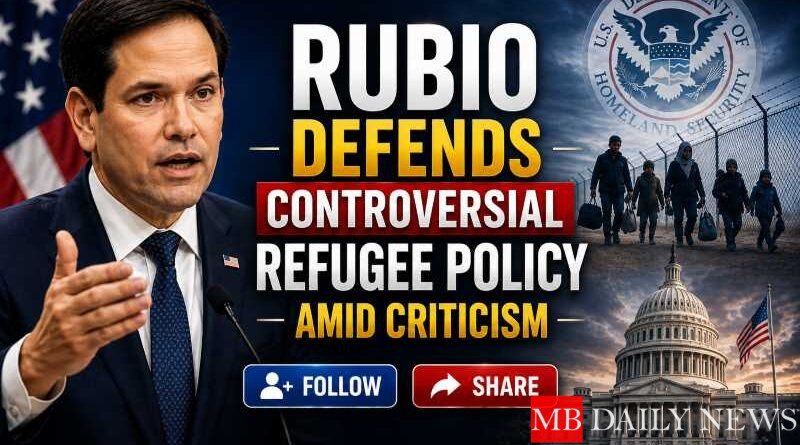
Rubio Defends Controversial Refugee Policy Amid Criticism
MB DAILY NEWS | Raleigh, NC.
During a recent congressional hearing, Secretary of State Marco Rubio defended the administration’s refugee policy. However, lawmakers challenged the approach and questioned its priorities.
The debate focused on President Trump’s refugee agenda, which has sharply reduced refugee admissions. As a result, critics argue that the policy limits humanitarian protections and favors a narrow group of applicants.
In a recent report for MB Daily News, I examined the broader implications of this strategy. Specifically, the administration has largely restricted refugee admissions while making notable exceptions for white South Africans. Consequently, the policy has attracted criticism from lawmakers, advocacy groups, and immigration experts.
Trump’s Refugee Agenda: Selective Resettlement Practices
At an event in April, President Trump stated, “We suspended all refugee resettlement.” He then highlighted exceptions for what he described as “persecuted South Africans.”
This statement reflects a central feature of the administration’s refugee policy. According to recent figures, the United States admitted 6,069 refugees since October. Of that total, 6,066 came from South Africa.
Consequently, critics have raised concerns about fairness and consistency within the refugee system. Furthermore, many argue that the policy conflicts with longstanding humanitarian principles that traditionally guide U.S. refugee admissions.
“The policy appears to prioritize certain groups based on race, which is deeply concerning,” said a human rights advocate familiar with the issue.
At the same time, similar debates have emerged in recent immigration discussions, placing the controversy within a broader national conversation.
Rubio Defends the Policy
During the hearing, Rubio defended the administration’s position by emphasizing assimilation.
According to Rubio, the government prioritizes applicants who can quickly integrate into American society. He argued that some South Africans have a strong likelihood of adapting rapidly and succeeding economically in the United States.
“We have assessed that there is real interest from a unique subset of people in South Africa who would be interested in coming to the United States and who have a high likelihood of rapid assimilation and success in our society,” Rubio explained.
As a result, administration officials continue to frame the policy as a matter of national interest rather than demographic preference.
Debate Over Afghan Refugees
Rubio’s remarks immediately drew criticism from Democratic Representative Grace Meng of New York.
Meng pointed to the successful integration of Afghan refugees in her district. Moreover, she argued that refugee contributions should not be judged primarily through selective criteria.
According to Meng, many Afghan families have become active members of their communities. Their experiences, she noted, demonstrate that refugees from diverse backgrounds can thrive in the United States.
“We have welcomed Afghan families who have become our neighbors and friends,” Meng said.
Her comments reinforced a broader argument that refugee success depends on opportunity and support rather than country of origin.
Broader Political Implications
The dispute surrounding Trump’s refugee agenda reflects deeper political divisions.
On one side, supporters argue that immigration policies should prioritize national interests and successful integration. On the other hand, critics contend that the current approach undermines humanitarian commitments and creates unequal standards.
Consequently, refugee policy has become a focal point in larger debates about race, identity, immigration, and American values.
Humanitarian Concerns
Beyond politics, the issue carries significant human consequences.
Many refugees flee persecution, conflict, and instability. Therefore, advocates argue that the United States should maintain a more inclusive resettlement system.
Furthermore, humanitarian organizations warn that restrictive policies may leave vulnerable populations without access to safety and protection. For this reason, they continue to push for broader refugee admissions and more equitable selection processes.
Looking Ahead
As the immigration debate continues, refugee policy will likely remain under intense scrutiny.
The administration’s emphasis on assimilation and selective resettlement continues to generate controversy. Meanwhile, advocates and lawmakers are calling for reforms that expand access and strengthen humanitarian protections.
Ultimately, the future of refugee admissions will shape not only immigration policy but also public perceptions of American values and international leadership. The discussion remains highly consequential for policymakers, refugees, and communities across the country.