

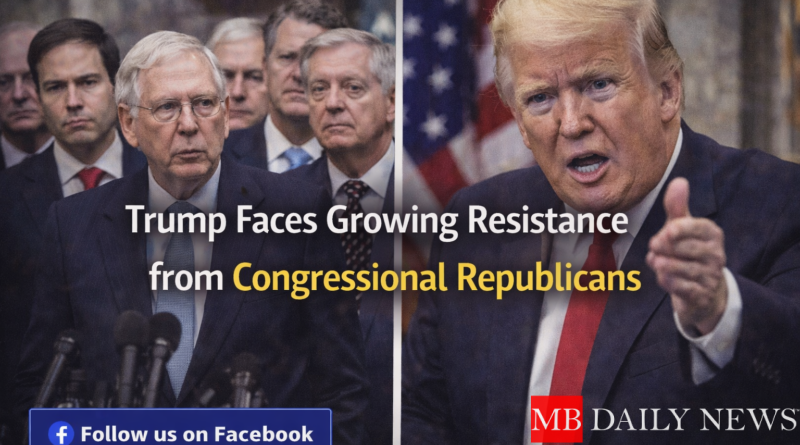
Congressional Republicans resist Trump: Trump Faces Growing Resistance from Congressional Republicans
MB DAILY NEWS | Raleigh, NC.
Congressional Republicans resist Trump: In a significant turn of events on Capitol Hill, several Congressional Republicans are increasingly pushing back against President Trump’s directives, signaling a potential shift in the party’s dynamics. This friction came to light during recent negotiations over the Foreign Intelligence Surveillance Act (FISA), which is facing an impending expiration. While the White House has urged lawmakers to reauthorize the surveillance law without amendments, a faction within the Republican Party is advocating for stronger privacy protections, illustrating a rift that could have broader implications for Trump’s influence over Congress.
In a recent investigative report by MB Daily News, I took a closer look at the unfolding struggle, which has seen GOP leaders trying to maintain the status quo while a segment of their ranks demands reform. The urgency of the situation was underscored when the House, facing a late-night deadline, managed to pass a short-term extension of FISA, buying time for further discussions. This extension, now due by April 30, reflects not just a procedural maneuver but a growing dissent among Republicans regarding Trump’s approach to governance.
Internal Divisions Surface
The debate over FISA has revealed deep-seated divisions within the Republican Party, particularly among its more libertarian-leaning members. These lawmakers are increasingly vocal about their concerns regarding privacy rights, challenging the party leadership’s preference for a straightforward reauthorization. This internal conflict is notable; it marks a departure from the previously unified front that characterized the party’s dealings with the Trump administration.
Beyond Surveillance: A Broader Rebellion
The tensions over FISA are not isolated. Just hours before the surveillance law debate, the House passed a bipartisan bill aimed at reinstating temporary legal protections for Haitian immigrants. This 224-204 vote represents a rare moment of GOP defiance against Trump’s policies, particularly considering his past derogatory remarks about Haitian immigrants and his efforts to rescind their Temporary Protected Status. Such actions highlight a growing willingness among Republicans to break ranks with the White House.
“In my view, this development matters not only for the immediate political moment, but for the wider conversation it may intensify.”
“This is a significant moment for the party, showcasing that not all members are willing to follow Trump’s lead unquestioningly.” In that sense, the story also echoes similar developments that have surfaced around the same issue in recent coverage, adding a wider frame to the immediate headline.
Implications for Trump’s Agenda
The resistance from Congressional Republicans raises important questions about the future of Trump’s legislative agenda. With key policy issues on the table, such as immigration reform and surveillance laws, the president’s ability to rally his party may be waning. This shift could have far-reaching consequences, not just for his administration but also for the Republican Party’s cohesiveness as it approaches the next electoral cycle.
“What recent political coverage has shown is that similar flashpoints rarely stay contained for long.”
Political Fallout and Future Prospects
As these dynamics evolve, the implications extend beyond immediate policy decisions. The growing dissent among Republicans signals a potential recalibration of party priorities, especially as midterm elections loom. Lawmakers may feel increasing pressure to align with their constituents’ views rather than the White House, setting the stage for a more fragmented Republican landscape.
A New Era of GOP Governance?
The recent developments suggest that Trump’s hold over Congress may be slipping, as more lawmakers prioritize their political survival and the interests of their constituents. This shift could reshape the Republican Party’s identity, leading to a reevaluation of its core principles and strategies moving forward. As the party grapples with these changes, the question remains: will this push for independence from Trump lead to a stronger, more unified party, or will it deepen existing fractures?