
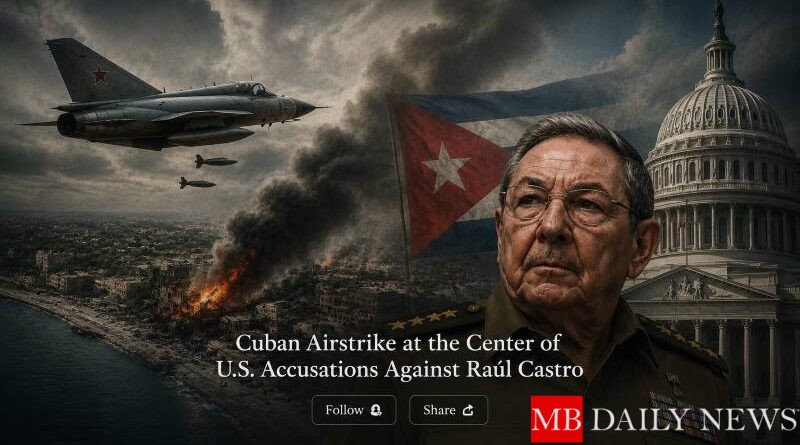
Cuban Airstrike at the Center of U.S. Accusations Against Raúl Castro
MB DAILY NEWS | Raleigh, NC.
More than three decades after a deadly military attack near the Florida coast shocked the international community, the incident has once again become a focal point in accusations against former Cuban leader Raúl Castro.
According to U.S. authorities, the fatal airstrike carried out by Cuban military forces against two civilian aircraft remains a key element in the criminal case surrounding Castro’s role in the Cuban government during the 1990s.
The tragedy, which occurred over international waters between Cuba and Florida, resulted in the deaths of four Cuban exile activists based in Miami.
Cuban Fighter Jets Shot Down Civilian Aircraft
The two small planes belonged to “Brothers to the Rescue,” a Miami-based humanitarian organization formed by Cuban exiles. The group was known for conducting missions aimed at locating and assisting Cuban migrants attempting dangerous sea crossings to the United States.
On February 24, 1996, Cuban fighter jets intercepted and destroyed both aircraft while they were flying near Cuban airspace. All four men aboard were killed instantly.
Among the victims was activist Carlos Costa, whose death became symbolic of the growing tensions between Havana and Washington.
The Cuban government defended the military operation at the time, claiming the aircraft had repeatedly violated Cuban airspace. However, international investigators and U.S. officials strongly condemned the attack, arguing the planes were operating in international airspace when they were shot down.
International Condemnation Intensified Pressure on Cuba
The attack triggered widespread international outrage and intensified criticism against the Cuban regime led by Fidel Castro.
Raúl Castro, who was serving as Cuba’s Minister of the Armed Forces during the incident, faced particular scrutiny due to his military leadership role.
The United Nations and several Western governments condemned the use of military force against civilian aircraft, calling it a violation of international law and human rights principles.
The event significantly worsened diplomatic relations between Cuba and the United States, marking one of the most serious confrontations between the two nations since the Cold War.
U.S. Sanctions Against Cuba Hardened After the Attack
Following the deadly incident, the administration of then-U.S. President Bill Clinton responded by strengthening economic sanctions against Cuba.
The attack directly influenced the approval of the Helms-Burton Act, legislation designed to tighten the U.S. embargo and limit foreign investment in Cuba.
Political analysts argue the airstrike effectively ended any immediate possibility of diplomatic dialogue between Washington and Havana during that period.
More than 30 years later, the event continues to shape political and legal debates surrounding Cuba’s leadership and its long-standing conflict with the United States.
The Legacy of the 1996 Airstrike Still Resonates
The resurfacing of the case underscores how unresolved historical events continue to impact international relations and political accountability.
For many Cuban exiles and human rights advocates, the victims of the 1996 attack remain symbols of resistance against authoritarianism in Cuba.
As legal and political scrutiny surrounding former Cuban officials continues, the deadly airstrike remains one of the darkest chapters in modern U.S.-Cuba relations.