
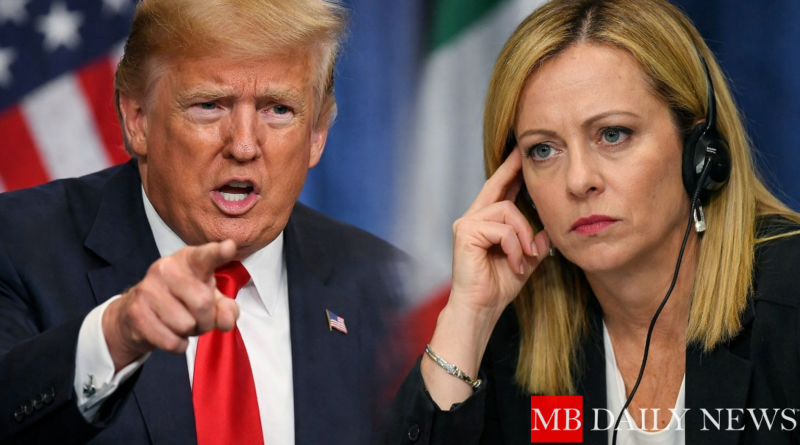
Trump And Meloni Relations | Trump’s Fractured Ties with Italy’s Meloni Highlight Shifting Alliances
MB DAILY NEWS | Raleigh, NC__By Javier Zelaya
In international politics, alliances are rarely static—but few expected the relationship between former U.S. President Donald Trump and Italian Prime Minister Giorgia Meloni to unravel this quickly. What once appeared to be a natural ideological partnership has shifted into a tense and very public disagreement, raising new questions about the durability of political loyalty on the global stage.
For years, Meloni was seen as one of Trump’s strongest European counterparts. Their shared conservative messaging, nationalist tones, and mutual praise created what many analysts described as a “transatlantic alignment of ideology.” But this week, that narrative took an unexpected turn.
“This isn’t just a disagreement—it’s a signal,” a European political analyst told me. “When leaders who once aligned so closely begin to clash publicly, it reveals deeper fractures beneath the surface.”
A Sudden Shift in Tone
The tension escalated after Trump openly criticized Meloni in an Italian publication, accusing her of lacking “the courage to stand firmly with Washington” during a sensitive geopolitical moment. The remark didn’t go unnoticed—and more importantly, it didn’t go unanswered.
Meloni, who has historically avoided direct confrontation with Trump, broke that pattern. In a rare public response, she condemned his recent comments about Pope Leo, calling them “unacceptable” and “out of line with the respect expected between leaders.”
That moment marked a clear turning point.
“It’s one thing to disagree privately,” said a Rome-based diplomat. “It’s another to draw a line in public. Meloni did the latter—and that changes everything.”
Cracks in a Once-Stable Alliance
The breakdown in Trump and Meloni relations reflects a broader pattern that has followed Trump’s political approach: alliances often hinge on personal loyalty rather than long-term strategic alignment. When that loyalty is perceived to waver, tensions tend to surface quickly.
Meloni’s recent distancing—particularly following controversial developments in the Middle East—suggests she is recalibrating her position, not just toward Trump, but toward global expectations of leadership.
This shift matters. Italy holds significant influence within the European Union, especially among conservative factions. If Meloni begins to move away from Trump’s orbit, others may follow.
The Bigger Picture for U.S.–Europe Relations
The implications extend beyond two leaders exchanging criticism. At a time when global crises demand coordination, fractures like this can weaken broader diplomatic cohesion.
“Strong alliances are built on trust and consistency,” one policy advisor noted. “When unpredictability enters the equation, partners start looking elsewhere.”
Trump’s history of strained relationships with international leaders—from NATO allies to trade partners—adds context to the situation. The fallout with Meloni may not be isolated, but rather part of a continuing pattern that could leave the U.S. with fewer reliable allies.
A Moment of Reflection—or Further Division?
As both leaders navigate domestic pressures and international expectations, the question remains: is this a temporary disagreement or the beginning of a longer-term shift?
There is still room for recalibration. Diplomatic relationships, especially at this level, are rarely beyond repair. But rebuilding trust requires more than shared ideology—it demands consistency, respect, and a willingness to engage beyond political convenience.
Looking Ahead
For now, the future of Trump and Meloni’s relationship remains uncertain. What is clear, however, is that the stakes go far beyond personal dynamics. The direction this relationship takes could influence not only U.S.–Italy ties, but also the broader alignment of Western alliances.
And in a world already navigating instability, that’s something no global leader can afford to ignore.
As one senior European official put it:
“Partnerships aren’t tested when things are easy—they’re tested when they’re not. And right now, we’re seeing exactly where those limits are.”